Workplace Recovery Support for
Small Business Information Systems:
MS Windows Server 2008 and 2008 R2 Failover Cluster Solutions
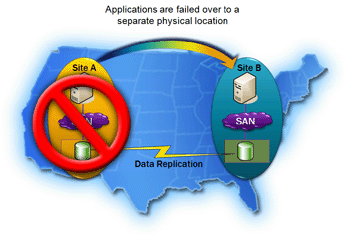 Clustering is a key technique to achieve maximum fault tolerance. A cluster is a collection of computer systems responsible for running a shared set of applications and services. The systems in the cluster are interconnected through hardware and software in such a way that in case any component in the cluster stops functioning, the workload will "failover" to, or be assumed by, another system in the cluster without a disruption of service.
Failover clustering clearly has an advantage in increasing network availability in the case of a hardware breakdown, but it also allows non-disruptive system maintenance for environments that have no time window when key applications such as email or web commerce can be taken offline without hurting business. For geographically dispersed environments, multi-site clustering provides insurance against natural disasters such as earthquakes or hurricanes.
The Enterprise and Datacenter editions of Windows Server 2008 included significant improvements in failover clustering such as easier deployment, management, and migration; enhanced support for multi-site clusters; improved security architecture and quorum models; stronger authentication and encryption; and more efficient tools for backup and recovery. Windows Server 2008 R2 offers even more advanced support for clustering through the addition of features that make clusters more secure, more available, and easier to manage. Major clustering improvements in Windows Server 2008 R2 include Live Migration support through Cluster Shared Volumes, enhanced support for IPsec security, and expanded cluster storage.
Progent offers a full range of Windows Server 2008 Server consulting services and Windows Server 2008 R2 expertise and can assist businesses of any size to maintain and troubleshoot failover clusters powered by Windows Server 2008. If you are considering an upgrade to a modern version of Windows Server, Progent can provide Windows Server 2019 migration expertise and Windows Server 2016 failover clustering consulting to maximize the availability and performance of your system.
New and Improved Features of Windows Server 2008 Failover Clustering
The failover clustering capabilities incorporated into Microsoft Windows 2008 Server represents more than a decade of Microsoft's experience in developing clustering technology. The Enterprise and Datacenter Editions of Microsoft Windows Server 2008 offer a number of new clustering services and capabilities including:
More Convenient Management Interfaces
Windows Server 2008 includes Microsoft Management Console (MMC) 3.0, a new easy-to-use interface for controlling network resources. The new Failover Cluster Administration Console is task oriented rather than cluster resource oriented. To make a file share highly available, for example, the administrator no longer has to create a group, a disk resource, an IP address resource, Network Name, configure IsAlive/LookAlive, configure preferred services, and set dependencies. Instead, the wizard simply asks for the Network Name. You do not necessarily need to assign an IP address because Windows Server 2008 failover clustering now supports DHCP.
Windows Server 2008 also supports remote management via the Remote Server Administration Tools (RSAT). You can manage multiple clusters throughout the organization from a single MMC. Windows Server 2008 Failover Clusters are also fully scriptable with Windows Management Instrumentation (WMI).
Built-in Cluster Validate Tool
Windows Server 2008 clustering includes a cluster Validate Tool, an expanded and integrated version of the ClusPrep tool released for Windows Server 2003 server clustering. As a part of the cluster configuration process, Validate runs a set of tests to determine whether the selected servers, cluster networks, and storage meet the requirements for failover clustering. Validate performs an inventory that includes BIOS information, operating systems, adapters, drivers and software updates; verifies cluster topology for redundancy; checks IP configuration details; and makes sure that storage can correctly handle simulated cluster actions. The Validate Tool helps prevents configuration errors, which is one of the most common problems encountered in failover clusters.
Support for Windows Server 2008 Server Core
Windows Server 2008 offers a Server Core installation option that supports failover clustering and provides a bare-bones environment for running distinct server roles. By limiting the services that need to be maintained and updated, this minimalist installation reduces support and management expense and enhances security by shrinking the server's attack surface. Server Core supports a variety of important roles including DHCP server, file services, print services, DNS server, Active Directory Domain Services, streaming media services, and Windows Server 2008 virtualization.
Better Storage and Backup Support
Improvements in storage and backup offer increased stability and availability for failover clusters. Support for both Master Boot Record (MBR) and GUID Partition Table (GPT) disks allows the creation of disks greater than 2 terabytes. Built-in logic initiates self healing automatically as long as the system can find either the disk signature in the Master Boot Record or the SCSI inquiry page 0x83 data (VPD).
Support for Storage Area Networking (SAN) solutions is improved for storage hardware that supports SCSI-3 SPC3-compliant SCSI commands for persistent reservation/release. All multi-path solutions are Microsoft Multipath I/O (MPIO). The Device Specific Module (DSM) provided by the storage vendor is responsible for sending PR registration information down each path to the storage system. Closer integration with Volume Shadow Copy Service (VSS) makes the backup process easier. Failover clustering in Windows Server 2008 has its own VSS.
Greater Expandability
With Windows Server 2008, x64-based failover clusters support up to 16 nodes in a single cluster, as opposed to the maximum of 8 nodes in Windows Server 2003. Windows Server 2008 failover clusters also now support GPT disks, which use the GUID partition table (GPT) disk partitioning system. A GPT disk allows up to 128 primary partitions and a much larger volume size. In comparison, MBR disks can support up to four primary partitions and a volume size limit of up to 2 terabytes. For greater reliability, GPT disks offer replication and cyclical redundancy check (CRC) protection of the partition table. The increased number of nodes plus support for GPT disks dramatically extends the scalability of larger volumes in cluster environments.
A New Quorum Model
Windows Server 2008 introduces a new failover clustering quorum model that incorporates a combination of Microsoft's earlier shared disk and majority node set models. In Windows Server 2008 failover clustering there are now four ways to establish a quorum:
- No Majority - Disk Only (same as Windows Server 2003 shared disk quorum)
- Node Majority (same as the Windows Server 2003 majority node set)
- Node and Disk Majority
- Node and File Share Majority
An Improved Security Model
Windows Server 2008 failover clustering incorporates a new security model that enhances its security and dependability. Changes include:
- Elimination of the need for a domain user account for the Cluster Service Account (CSA)
- Better logging and event tracing
- Transition from unsecure datagram remote procedure call (RPC) communications to TCP-based RPC communications
- Default enabling Kerberos authentication on all cluster network name resources
- The ability to audit access to the cluster service via either the Failover Cluster Management snap-in or the cluster command-line interface
- Ability to secure Inter-Cluster communications.
New Networking Capabilities and More Flexible Dependencies
Windows Server 2008 failover clustering includes a new networking model. Major improvements include:
- Enhanced support for geographically distributed networks
- The ability to place cluster nodes on different networks
- The ability to use DHCP server to assign IP addresses to cluster interfaces
- Improvements in the cluster heartbeat mechanism
- Support for IPv6
Cluster IP address resources can now get their addressing from DHCP servers as well as from static entries. The cluster heartbeat mechanism has moved from a UDP broadcast health checking mechanism to a UDP unicast communication that it uses a Ping-like Request-Reply process. This allows better security and more reliable packet sequence numbering. Windows Server 2008 supports IPv6 IP Address resources and IPv4 IP Address resources either alone or in combination in a cluster. Clustering also supports 6-4 and Intra-site Automatic Tunneling Addressing Protocol (ISATAP).
Enhancements to Failover Clustering In Windows Server 2008 R2
Major enhancements to Failover Clustering available with Windows Server 2008 R2 include:
- Clustered Shared Volumes (CSV) with dynamic I/O redirection
- Geographically dispersed clustering for immunity from natural disasters
- Easier setup and migration through the new Best Practices Analyzer
- Redundant Quorum Resource to eliminate single-point failure for the cluster quorum
- Improved security through support for IPsec security between client and cluster nodes
- Supports for GPT disks that exceed 2 terabytes in capacity
How Progent Can Help You Benefit from Microsoft's Failover Clustering
Progent's Microsoft-certified consultants can help you evaluate the business benefits of Windows Server 2008 or Windows Server 2008 R2 failover clustering, set up pilot programs to validate performance and compatibility for your key workloads, develop and execute a cost-effective deployment plan, train your IT staff to manage your clustering environment, and provide ongoing consulting and technical support services remotely or at your site. Progent can also provide comprehensive Help Desk services.
Progent's service professionals can also help you migrate from Windows Server 2003 cluster nodes. This migration requires experience because these two types of nodes cannot share the same cluster, which eliminates a rolling migration.
If you currently have a clustering environment based on Windows Server 2008 R2 and are considering a move to Windows Server 2019 or Windows Server 2016, Progent can help you plan and carry out a Windows Server 2019 failover clustering upgrade or create a Windows Server 2016 disaster recovery solution.
Progent's CISM, CISA, GIAC, CISSP, and CRISC certified security engineers can assess the protection offered by your cluster environment and can recommend and implement affordable improvements. Progent's security experts can also help you design, document, and test business continuity and disaster recovery plans.
Zero-Downtime Solutions Offered by Progent's Consultants
Progent's Microsoft and Cisco-certified support professionals can help your business to build an affordable, zero-downtime IT architecture that addresses critical challenges encompassing a wide array of networking technologies and processes including:
Disaster Recovery Planning
Progent's disaster recovery professionals can help you design a disaster recovery plan that will allow you to resume network functionality in the event of an IT system disaster. Progent can assist you to define a complete disaster recovery strategy that incorporates periodic disaster recovery assessments and testing. Progent's Microsoft and Cisco-certified professionals can also show you how to build an affordable, non-stop network architecture that takes into account reliability issues involving a wide range of network technologies and procedures. For details, see Workplace Recovery Consulting.
CRISC-Certified IT Risk Mitigation
The Certified in Risk and Information Systems Control (CRISC) certification program was initiated by ISACA in 2010 to verify a consultant's ability to design, deploy, and maintain IS control mechanisms to mitigate network risk. Progent can provide the expertise of a CRISC-certified consultant to help you to develop and execute a business continuity or disaster recovery strategy that follows leading practices promoted by CRISC and crafted to align with your organization's risk appetite, business objectives, and budgetary guidelines. To find out more, visit CRISC-Certified network risk control specialists.
Windows Server 2019 Fault-tolerant Failover Clustering
Microsoft Windows Server 2019 introduced important improvements in capacity, performance, manageability, security and compliance, application compatibility, Linux co-existence, Kubernetes networking, and hybrid combinations of on-premises and cloud-hosted resources. Top new features of Windows Server 2019 include Windows Admin Center for unifying the management and monitoring of hybrid on-premises/cloud deployments, System Insights for utilizing advance predictive intelligence to manage local networks, Windows Defender ATP Exploit Guard for host-intrusion prevention, container orchestration with Kubernetes, Cluster Sets technology for creating and managing large non-stop scale-out clusters, and Storage Migration Service for streamlining the upgrade process from outdated editions of Windows Server. For more information, go to Microsoft Server 2019 Fault-tolerant Failover Clustering Support.
Windows Server 2016 Disaster Recovery
Progent's Windows Server 2016 disaster recovery consultants can help you to design a DR solution built around Microsoft's most advanced Failover Clustering technologies such as Cluster OS Rolling Upgrade for non-disruptive migration to Windows Server 2016, Storage Replica for crash-consistent recovery, Storage Spaces Direct for enterprise-class storage clusters using low-cost equipment, Virtual Machine Load Balancing for enhancing the performance and fault-tolerance of Failover Clusters while reducing TCO and operational expenses, and Cloud Witness for fast, economical creation of a failover cluster quorum arbitration point. To learn more, see Windows Server 2016 Disaster Recovery and Business Continuity Expertise.
VMware Site Recovery Manager (SRM) Disaster Recovery Solutions
VMware's Site Recovery Manager (SRM) is a component of VMware vCenter that allows you to define, automate and verify a repeatable runbook for recovering services rapidly following a breakdown. Site Recovery Manager supports centrally controlled and automated disaster recovery, application mobility, plus transparent site relocation, failback and re-protect. Site Recovery Manager also allows non-intrusive testing for disaster recovery, upgrades and fixes and can produce audit reports to verify full service recovery, validate Service Level Agreements and demonstrate DR compliance. Progent offers the support of a VCDX certified VMware SRM consultant to assist your organization to design, configure, test and manage a DR solution based on VMware SRM.
NetApp MetroCluster Disaster Recovery Technology
NetApp MetroCluster is a disaster recovery platform that uses array-based storage clustering with synchronous replication to deliver fast, zero data loss disaster recovery between sites located as far as 185 miles (300km) apart. Progent can provide online or on-premises access to a certified NetApp MetroCluster expert who can assist your business to plan, configure, administer, update, test and troubleshoot a disaster recovery system built around NetApp MetroCluster. Progent can help you to select an architecture for your MetroCluster deployment that meets your functional requirements and budget. Progent can ensure you adhere to leading practices for configuring your MetroCluster environment by delivering help with procedures like assigning disk pools, determining plexes layout, setting up volumes, setting up NetApp Snapshot, provisioning switches, designing a tiebreaker, setting up a TCP/IP configuration replication network between your peered clusters, and verifying your MetroCluster DR solution to verify adherence with industry standards and regulatory mandates.
High Availability Load Balancing
Progent provides high availability load balancing consulting covering system load balancing, load balanced applications, network backbone routing, and content delivery technology including F5 Networks 3DNS. Fault tolerant load balancing products for which Progent offers consulting services include Microsoft Windows 2003 and 2008 Server Network Load Balancing Manager, Citrix Access Suite and Presentation Server, Cisco Content Services Switch, Cisco Distributed Director and Cisco CDN Software, and F5 Networks BIG-IP. For more information, visit Fault Tolerant Load Balancing.
Non-stop Colocation
Progent's Data Center professionals can help you identify zero-downtime data centers that meet the specific requirements of your business. High availability co-location sites are particularly appealing to small and mid-size businesses because of their affordability and simplified logistics compared to pursuing a do-it-yourself strategy. Trying to create an on-site data center that offers even a minimum level of fault tolerance is too costly for the majority of small organizations. Progent is ready to show you how to get all the benefits of 24x7 data centers by providing a full array of engineering and support services. To read more, go to High-Availability Data Centers Consulting.
24x7 Interoffice Networking
Progent's branch office connection consultants can help businesses achieve non-stop branch office connectivity solutions through redundant system architectures featuring automatic failover. Progent's Cisco-premier CCIE engineers can plan and deploy ultra-reliable Inter-office networks supported by zero-downtime EIGRP network routers or non-stop OSPF configurations of Cisco routers. Progent can demonstrate how redundant connections and transparent fail-over can provide affordable non-stop interoffice networking. For details, see Failsafe Inter-office Networking.
Fault Tolerant Internet Connectivity
Progent's Cisco-certified network professionals can help you build an economical, fault tolerant Internet configuration solution that can deliver 24x7 Internet connectivity through a broad range of high availability Internet access technologies including non-stop BGP, automatic fail-over, and redundant ISPs. Progent can provide CCIE consultants to help you utilize the latest technology for fault tolerant Internet connections to build a cost-effective, completely redundant Internet network with automatic failover and other capabilities to deliver zero-downtime Internet availability. To find out more, see Fault Tolerant Internet Access Architecture.
Backup and Restore Solutions Consultants
Progent can provide economical online support from consultants with expertise in a broad array of products and services that deliver solutions for protecting Microsoft Windows, Mac, and Linux/UNIX physical and virtual servers and desktops as well as notebooks and smartphones. Progent can provide help for leading backup products including Acronis, Backup Exec, BackupAssist, HP Data Protector, Double-Take Software, Mozy, Retrospect for Macintosh, Apple Time Machine, VMware Data Recovery, and Solaris FLARs. Progent can help your company to deploy, upgrade, or troubleshoot backup solutions for a variety of topologies such as local, edge to datacenter, cloud, or a mix. To learn more, visit Backup and Recovery Technology Consulting and Support Services.
System Center Data Protection Manager Backup and Restore Consultants
Progent's certified Microsoft SCDPM consultants can assist you to create a practical workplace recovery strategy, design an affordable high-availability IT infrastructure, deploy a SCDPM-based backup and restore solution, thoroughly validate your DPM system, train your IT personnel or local service providers how to manage Microsoft SCDPM, or provide extensive information technology outsourcing services such as off-site housing of System Center Data Protection Manager machines in Progent's data center. To read more, see System Center Data Protection Manager Expertise.
Barracuda Backup Local, Offsite and Cloud Data Backup and Disaster Recovery
Barracuda Backup is an affordable, subscription-based backup and disaster recovery service for small and medium-size businesses. A Barracuda Backup deployment can incorporate a custom-designed physical appliance built by Barracuda or a virtual appliance with similar functionality but which utilizes your existing storage infrastructure. Barracuda Backup safeguards vital company data generated on-premises, at one or more remote locations, or in the cloud. For disaster protection, you can replicate data to the Barracuda Cloud, to Amazon AWS, or to any location with a Barracuda Backup appliance. Progent is a certified Barracuda partner and Progent's Barracuda Backup consultants can provide a broad range of consulting services to assist you to plan, integrate, manage and repair a backup and disaster recovery solution based on Barracuda Backup. For more information, go to Barracuda Backup and disaster recovery consulting and management.
ProSight Altaro VM Backup Software for Data Protection and Disaster Recovery
Hornetsecurity's Altaro VM Backup software provides small businesses a reliable and affordable solution for backing up and restoring Hyper-V and VMware-powered virtual machines. Altaro VM Backup can be deployed in local, remote, distributed, and cloud architectures and also supports cost-effective backup to Microsoft Azure Block Blob storage. Altaro VM Backup supports advanced capabilities such as Immutable Cloud Storage for an extra layer of protection from ransomware. Progent is a Hornetsecurity Altaro partner and can provide a broad array of online or on-premises services to help you to design, install, optimize and debug a comprehensive backup and disaster recovery system based on Altaro VM Backup software. With ProSight DPS Altaro VM Backup, Progent delivers a fully managed backup/restore service based on Altaro VM Backup software. To read more, see Altaro VM Backup certified consultants.
ProSight DPS 365 Total Backup Solutions for Microsoft 365
Microsoft 365 offers rudimentary archiving but does not include native support for key data protection capabilities such as Exchange Online backups or greater than 30-day point-in-time recovery for OneDrive or SharePoint Online. Hornetsecurity's 365 Total Backup provides a full-featured platform for automatic backup and quick recovery of all your company's M365 mailboxes, Teams Chats, SharePoint documents, OneDrive data, and content on Windows endpoints. Progent is a certified Hornetsecurity/Altaro partner and has designed ProSight Data Protection Services 365 Total Backup to provide end-to-end managed services for Hornetsecurity's 365 Total Backup suite. ProSight Data Protection Services 365 Total Backup provides an affordable backup-as-a-service alternative that defends M365 apps against data loss caused by human or software error, malevolent corruption, and malware attacks such as ransomware. For details, visit ProSight DPS 365 Total Backup solutions for Microsoft 365.
Fully Managed Cloud Backup: ProSight Data Protection Services ECHO
ProSight Data Protection Services ECHO provide small and medium-sized organizations an affordable end-to-end solution for reliable backup/disaster recovery (BDR). For a fixed monthly cost, ProSight Data Protection Services ECHO automates your backup processes and allow fast restoration of vital files, apps and VMs that have become lost or corrupted as a result of component failures, software bugs, natural disasters, human error, or malware attacks like ransomware. ProSight DPS ECHO can help you back up, retrieve and restore files, folders, applications, system images, as well as Microsoft Hyper-V and VMware virtual machine images. Critical data can be protected on the cloud, to an on-premises storage device, or mirrored to both. Progent's BDR specialists can provide advanced support to set up ProSight DPS ECHO to to comply with regulatory standards such as HIPAA, FINRA, PCI and Safe Harbor and, when needed, can assist you to recover your critical information. Read more about ProSight DPS ECHO managed backup and recovery.
ProSight MSP360 Backup Services
Progent can assist your company to create, deploy and debug a backup/restore plan built around MSP360 software. MSP360 enables file/folder or image backup/restore for virtual machines and physical machines, works with all leading public clouds, and permits you to create a data protection ecosystem with a low RTO and a granular Recovery Point Objective. With ProSight MSP360 Backup, Progent offers comprehensive monitoring and remote management of your backup environment to protect against data loss resulting from user miscues, computer errors, ill-intentioned users, and malware assaults such as ransomware. To read more, see ProSight MSP360 Backup solutions.
Consulting for Double-Take Software for Data Backup and Recovery
Double-Take Software offers a selection of products designed to deliver small and midsize companies a variety of affordable solutions for backing up and restoring vital workloads such as Microsoft Exchange, SQL, RIM Blackberry, and Microsoft SharePoint. Progent's disaster recovery planning consultants have extensive backgrounds incorporating Double-Take Software products into small business IT systems to create a high state of fault tolerance and disaster recovery readiness at a budget-friendly price. For more information, visit Consulting Services Double-Take Software for Data Backup.
Why Pick Progent for Disaster Recovery/Business Continuity Planning?
Because Progent is a Microsoft Certified AI Cloud Partner and provides high-level application support for a broad variety of small business software programs, Progent is able to help clients to find comprehensive information technology solutions that substantially enhance the business value of your network. As a Registered Partner with Cisco, Progent can provide the services of premier engineers and specialists with experience in architecting, deploying and troubleshooting networking environments based on Cisco products. The depth and breadth of Progent's IT experience and Progent's familiarity with the needs of small companies make Progent the ideal resource for creating and maintaining an affordable, high-availability network.
How You Can Get Help from Progent's Experts for Support for Fault Tolerant Computing
In order to ask Progent about consulting expertise for high availability computing, call
Select Topic: