Workplace Recovery Support
For Businesses of All Sizes:
Disaster Recovery/Business Continuity Planning Consulting Services
Business Continuity Planning vs. Disaster Recovery Planning
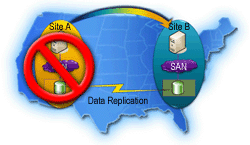 In case of a catastrophic event, whether natural or man-made, a sound business continuity/disaster recovery (DR/BC) strategy can make the difference between a business glitch and a calamity. Progent's DR/BC consultants can help small and mid-size companies design and test a contingency plan that incorporates advanced technologies and proven processes to get back in business quickly after a catastrophic network failure while at the same time working within a restricted IT budget.
The terms "business continuity planning" and "disaster recovery planning" are often used interchangeably, but it is useful to distinguish them. Business continuity planning takes a high-level, holistic view of a business to determine what personnel, physical resources, and operational processes are required to keep an organization running at some minimally acceptable level after a catastrophe and how to restore normal operations efficiently. Business continuity planning takes into account information technology issues, which are vital to any business, but also addresses areas beyond computing. Will you need temporary office space? Substitute vehicles? Alternate vendors? Replacement personnel? Do you have an emergency notification system in place to alert workers and other stakeholders? Are you required to file regulatory reports or contact insurers? Do you need access to emergency funding?
Progent can provide the services of experienced consultants who can help you follow best practices to create and document a high-level business continuity plan that deals with these critical questions and provides a cohesive game plan to follow in case of a disaster.
Disaster recovery planning is more focused on information technology issues and involves the down-to-earth details of how to keep your crucial IT operations running, protect your data, and restore full network functionality as quickly as practical. Progent can provide the services of a certified IT professional who can help you create and implement a disaster recovery plan that utilizes the latest generation of technologies designed to provide a high degree of fault tolerance and recoverability at historically low prices.
What Is Involved in Developing a Disaster Recovery Plan?
It is still relatively rare for small businesses to have a comprehensive business continuity plan in place, but only businesses with an insatiable appetite for risk should go without a disaster recovery plan. Disaster recovery planning should address the IT resources needed to maintain a defined level of operational capability and restore full network functionality as quickly as practical. The plan should anticipate a broad variety of disaster scenarios such as fires, storms, earthquakes, chemical accidents, flooding, pandemics, loss of key personnel, equipment or system failure, human error, and cyber crime.
You should assess the worst-case impact of each of these disaster scenarios on your network infrastructure and business processes and prioritize the areas that are most critical for you to protect in order to limit business disruption to an acceptable level. For each scenario, you should develop a recovery strategy that addresses your local and remote workers, customers, vendors, facilities, hardware and software, communication services, support contracts, and lead-times for replacing equipment and services and restoring data. Your recovery strategies should include specific action plans, escalation procedures, and data retention and restoration policies. You should also test the plan and train your employees responsible for carrying it out.
Progent's Process for Creating a Disaster Recovery Plan
Progent has developed an effective and affordable process for helping small business create a viable disaster recovery plan. This process involves seven distinct phases:
Phase 1: Business Impact and Risk Analysis
In this phase, you differentiate between critical and non-critical organization functions. A function is critical if its loss for any significant period of time would result in damage that stakeholders regard as unacceptable. You can't realistically decide that all network functions are critical because you have to consider the probable cost of establishing and maintaining rapid business or technical recovery solutions. You also have to take into account that some functions may be dictated by law or contractual obligations. Progent can help you make informed prioritization decisions by assessing the cost and timing issues associated with various recovery strategies.
Once you have identified critical organization functions, you have to establish two values for each function:
- Recovery Point Objective (RPO) - the acceptable latency of data that will be recovered
- Recovery Time Objective (RTO) - the acceptable amount of time to restore the function
The Impact and Risk Analysis phase results in the recovery requirements for each critical function. The recovery requirements consist of:
- The business requirements for recovery of the critical function
- The technical requirements for recovery of the critical function
After you complete the Business Impact and Risk Analysis phase, the business and technical plan requirements have to be documented before you can move on to the solution design and implementation phases. Progent is experienced in generating this vital documentation quickly and can work with your asset management team, if you have one, to identify available and re-allocateable resources you can use for disaster recovery.
Phase 3: Solution Design
The goal of the Solution Design phase is to identify the most cost-effective disaster recovery solution that meets the requirements identified in the Business Impact and Risk Analysis stage. For your critical IT applications, this means determining how the minimum application and application data requirements can be restored within the target timeframe. Disaster recovery plans may also have to address areas beyond IT applications. A common example is the requirement to preserve information in hard copy format. Progent's expertise with Microsoft and Cisco technology, business application programming and support skills, experience providing Internet data center consulting and network management services, and extensive background helping small business recover from catastrophic network failures ensure that the solutions Progent proposes take full advantage of advanced technology to keep costs down while maximizing the chances of success.
Key areas defined in the Solution Design phase include:
- The crisis management command structure
- The location of a secondary work site (where necessary)
- Telecommunication architecture between primary and secondary work sites
- Data replication methodology between primary and secondary work sites
- A backup plan that features immutability, air gapping, and offsite backup
- The application, hardware, and software required at the secondary work site
- The type of physical data requirements at the secondary work site.
The Implementation phase is the most important part of a disaster recovery plan and features the execution of the design elements identified in the Solution Design phase. Work package testing may take place during the implementation of the solution. Progent's skills as system integrators come into play in this phase and help minimize the time and cost required to roll out a viable solution.
Phase 5: Testing and Verification of Technical Solutions
Testing and adjusting recovery plans for specific anticipated scenarios is another critical element of a viable disaster recovery program. The complexity of fault-tolerant networks requires rigorous testing to verify that a recovery plan is feasible and that assigned responsibilities are understood. Recovery exercises will show whether backed-up data can be usefully restored, alternative connectivity technology provides adequate performance under realistic loads, fault-tolerant technologies perform failover processes as planned, and IT staff knows what is expected. Testing exercises will help you identify weak points in your recovery plan so you can make adjustments before disaster strikes. Progent's experience with system design and support ensure that the Testing and Verification phase of a disaster recover plan is thorough and meaningful without being unnecessarily protracted and costly.
Primary areas involved in the Testing and Verification phase of a business continuity plan include:
- Application security
- Hardware operability check
- Application operability/availability check
- Data verification
- Are all work processes for critical functions documented?
- Have the systems used in the execution of critical functions changed?
- Are the documented work checklists meaningful and accurate for staff?
- Does the recovery documentation include the proper order in which network components should be restored?
- Do the documented work process recovery tasks and supporting disaster recovery infrastructure allow staff to recover within the predetermined recovery time objective?
In this phase you resolve any issues or concerns that arose during the Testing and Verification phase. Any changes in the solution design that come about during this phase should be reflected in the associated disaster recovery documents. Progent's experience with disaster recovery solution design and implementation help keep test failures at a minimum and speed up remediation, saving clients time and money.
Phase 7: Handover
The handover of a turnkey disaster recovery solution includes three activities:
- The first activity in the Handover phase is to confirm the accuracy and completeness of the information contained in the written manual and the distribution of the documentation to the client's staff. Staff members whose roles are identified as critical for disaster response and recovery are provided training to ensure that they understand what they are expected to do and know how to do it.
- The second activity is testing and verification of technical solutions established for recovery operations.
- The third activity is an all-hands testing and verification of documented organization recovery procedures.
Progent's Microsoft and Cisco support professionals can assist your business to implement an efficient, zero-downtime system that resolves key problems covering a broad array of infrastructure solutions and processes including:
CRISC-Certified Network Risk Mitigation
The CRISC program was initiated by ISACA in 2010 to verify an IT professional's skills to design, implement, and maintain information system controls to reduce risk. Progent offers the expertise of a CRISC-certified engineer to assist you to create and carry out a workplace continuity strategy that follows leading practices promoted by CRISC and geared to align with your company's risk tolerance, business objectives, and IT budget. For more information, visit CRISC-Certified network risk mitigation experts.
Microsoft Windows Server 2019 High Availability Failover Clustering
Windows Server 2019 introduced important improvements in capacity, throughput, manageability, cybersecurity, application compatibility, Linux support, container networking, and hybrid integration of local and cloud-hosted resources. Top enhancements of Microsoft Windows Server 2019 are Windows Admin Center for unifying the management of hybrid local/cloud-hosted deployments, System Insights for utilizing advance predictive analytics to control local environments, Windows Defender ATP Exploit Guard for host-intrusion defense, container networking with Kubernetes, Cluster Sets technology for creating and administering massive non-stop scale-out clusters, and Microsoft's Storage Migration Service for streamlining the upgrade process from legacy versions of Windows Server. For more information, visit Windows Server 2019 Fault-tolerant Failover Clustering Support.
Windows Server 2016 Disaster Recovery
Progent's Windows Server 2016 disaster recovery/business continuity consultants can assist your organization to design a DR system based on Microsoft's cloud-tested Failover Clustering tools such as Cluster OS Rolling Upgrade for non-disruptive migration to Windows Server 2016, Storage Replica for zero-data-loss recovery, Storage Spaces Direct for high-performance network-attached storage using commodity equipment, VM Load Balancing for improving the speed and resilience of Failover Clusters while reducing TCO and operational expenses, and Cloud Witness for fast, economical creation of a stretch cluster quorum witness. To learn more, see Windows Server 2016 Disaster Recovery and Business Continuity Expertise.
VMware Site Recovery Manager (SRM) Disaster Recovery Solutions
VMware's Site Recovery Manager (SRM) is a component of VMware vCenter that allows you to orchestrate, automate and test a consistent runbook for restoring applications and services quickly following an outage. Site Recovery Manager supports centrally controlled and automated disaster recovery, application mobility, and non-disruptive site relocation, failback and site re-protect. Site Recovery Manager also enables transparent testing for disaster recovery, upgrades and patches and can produce reports to confirm complete service restoration, validate Service Level Agreements and prove DR compliance. Progent can provide the skills of a VCDX certified VMware Site Recovery Manager consultant to assist you to plan, deploy, test and administer a DR solution based on VMware Site Recovery Manager.
NetApp MetroCluster Disaster Recovery Platform
NetApp MetroCluster is a high-availability and disaster recovery software suite that combines array-based storage clustering with replication to deliver rapid, zero data loss disaster recovery between datacenters located as far as 185 miles apart from each other. Progent offers the skills of a certified NetApp MetroCluster consultant who can help you to plan, configure, manage, update, test and repair a disaster recovery system based on NetApp MetroCluster. Progent can help you to select a topology for your MetroCluster environment that aligns with your technical requirements and budget. Progent can make sure you adhere to best practices for configuring your MetroCluster solution by providing guidance with tasks such as assigning shelf IDs, arranging aggregate layout, provisioning NetApp FlexVol volumes, setting up Data ONTAP configuration replication service, installing switches, implementing a tiebreaker, setting up a configuration replication network between your storage clusters, and verifying your DR solution to verify compliance with industry standards and regulatory requirements.
High Availability Load Balancing
Progent provides fault tolerant load balancing support that addresses system load balancing, load balanced applications, network backbone routing, and content dispatching technology including F5 Networks 3DNS. High availability load balancing technologies for which Progent offers consulting expertise include Microsoft Windows 2003 and 2008 Server Network Load Balancing Manager, Citrix Metaframe and Presentation Server, Cisco CSS, Cisco Distributed Director and LocalDirector 400 series, and F5 Networks BIG-IP. For more information, see Non-stop Load Balancing.
Zero Downtime Colocation
Progent's Data Center consultants can help you select fault-tolerant data centers that match the specific needs of your business. High availability Internet Data Centers are especially attractive to small and mid-size organizations due to of their low cost and convenience in comparison to pursuing a do-it-yourself approach. Attempting to create an in-house data center with even a minimum degree of fault tolerance is too expensive for the majority of small businesses. Progent is ready to show you how to reap all the benefits of 24x7 data centers by offering a full range of engineering and support services. To read more, go to Fault Tolerant Data Centers Expertise.
Failsafe Branch Office Connectivity
Progent's multi-site network infrastructure consultants can help businesses achieve zero-downtime inter-site connectivity via fully redundant system architectures with transparent failover. Progent's Cisco-certified CCIE engineers can design and deploy high-availability Inter-office connections based on fault tolerant EIGRP network routers or fault tolerant OSPF configurations of Cisco routers. Progent can demonstrate how multi-path connections and automatic fail-over can provide economical non-stop interoffice networking. To learn more, see High-Availability Interoffice Networking.
Fault Tolerant Internet Connections
Progent's Cisco-certified IT engineers can show you how to design an affordable, high availability Internet configuration architecture that can deliver non-stop Internet connectivity through a broad range of fault tolerant Internet access technologies including non-stop BGP, transparent fail-over, and redundant ISPs. Progent can provide CCIE professionals to help you utilize the most advanced techniques for high availability Internet connectivity to implement a cost-effective, completely redundant Internet interface with automatic failover and other capabilities to deliver non-stop Internet availability. For details, visit Fault Tolerant Internet Access Solutions.
Backup and Restore Solutions Consulting Experts
Progent offers affordable online support from engineers skilled in a broad range of utilities and technologies that deliver solutions for protecting Windows, Mac, and Linux servers and desktops plus notebooks and smartphones. Progent can provide consulting support for leading backup platforms including Acronis Backup and Recovery, Symantec Backup Exec, BackupAssist Software, HP Data Protector, Double-Take, Mozy, Retrospect for Macintosh, Time Machine, VMware Data Recovery (VDR), and Solaris FLARs. Progent can assist you to design, enhance, or maintain backup/restore solutions for a range of architectures including on-premises, remote, cloud-based, or a mix. For more information, visit Backup and Recovery Technology Consulting Services.
Microsoft System Center Data Protection Manager (SCDPM) Backup and Restore Consulting and Support Services
Progent's expert System Center Data Protection Manager support professionals can help you to create an effective business continuity plan, implement an affordable high-availability IT infrastructure, install a Microsoft SCDPM-powered backup and recovery solution, thoroughly validate your DPM system, educate your administrative personnel or regular service providers how to manage Microsoft System Center Data Protection Manager, or provide extensive information technology outsourcing such as remote housing of Microsoft System Center Data Protection Manager servers in Progent's data center. To read more, see System Center Data Protection Manager (SCDPM) Consulting and Support Services.
Barracuda Backup Local, Offsite and Cloud Backup and Disaster Recovery
Barracuda Backup is a low-cost, subscription-based backup and disaster recovery service for small and mid-size organizations. A Barracuda Backup solution can incorporate a purpose-built hardware appliance built by Barracuda or a virtual appliance with similar features but which uses your existing storage infrastructure. Barracuda Backup protects critical business data generated on-premises, at one or more remote sites, or in the cloud. For disaster recovery, you can replicate data to the Barracuda Cloud, to Amazon AWS, or to any location with a Barracuda appliance. Progent is a Barracuda partner and Progent's Barracuda Backup consultants can provide a broad array of consulting support services to help you to plan, integrate, manage and debug a backup and disaster recovery system built on Barracuda Backup. For additional information, see Barracuda Backup and disaster recovery consulting and management.
ProSight Altaro VM Backup Software for Data Protection and Disaster Recovery
Altaro VM Backup software offers small organizations a dependable and affordable solution for backing up and recovering Hyper-V and VMware-based virtual machines (VMs). Altaro VM Backup can be deployed in on-premises, offsite, distributed, and cloud-hosted environments and also supports low-cost backup to Azure storage. Altaro VM Backup supports advanced capabilities like Immutable Cloud Storage for enhanced protection from ransomware. Progent is an Altaro partner and offers a broad range of online or on-premises consulting services to assist you to design, deploy, optimize and debug a modern backup and disaster recovery solution based on Altaro VM Backup software. With ProSight Data Protection Services Altaro VM Backup, Progent offers a fully managed backup/restore service based on Altaro VM Backup technology. For more information, see Altaro VM Backup certified consultants.
ProSight DPS 365 Total Backup Solutions for Microsoft 365
Microsoft 365 offers rudimentary archiving but does not include integrated support for vital data protection services such as Exchange Online backups or long-term point-in-time recovery for OneDrive for Business or SharePoint. Hornetsecurity's 365 Total Backup provides a full-featured platform for automatic backup and quick recovery of all your organization's M365 mail, Teams Chats, SharePoint sites, OneDrive data, and content on Windows endpoints. Progent is an authorized Hornetsecurity/Altaro partner and has designed ProSight Data Protection Services (DPS) 365 Total Backup to provide end-to-end management services for Hornetsecurity's 365 Total Backup suite. ProSight DPS 365 Total Backup provides a low-cost backup-as-a-service alternative that guards M365 components against data loss or corruption resulting from human or system error, malevolent sabotage, and cyber attacks like ransomware. For details, see ProSight DPS 365 Total Backup services for Microsoft 365.
Fully Managed Cloud Backup: ProSight Data Protection Services ECHO
ProSight Data Protection Services ECHO provide small and mid-sized organizations an affordable and fully managed service for reliable backup/disaster recovery. Available at a low monthly cost, ProSight DPS ECHO automates your backup processes and enable rapid restoration of vital files, applications and virtual machines that have become lost or damaged as a result of hardware breakdowns, software bugs, natural disasters, human mistakes, or malware attacks such as ransomware. ProSight Data Protection Services ECHO can help you back up, retrieve and restore files, folders, applications, system images, plus Microsoft Hyper-V and VMware images. Critical data can be protected on the cloud, to an on-premises device, or mirrored to both. Progent's backup and recovery specialists can deliver advanced expertise to configure ProSight DPS ECHO to be compliant with government and industry regulatory standards such as HIPAA, FINRA, and PCI and, whenever necessary, can help you to restore your business-critical data. Find out more about ProSight Data Protection Services ECHO managed backup.
ProSight MSP360 Backup Solutions
Progent's data protection experts can assist your company to design, deploy and troubleshoot a backup solution based on MSP360 software. MSP360 enables file or image backup/restore for VMs and physical machines, works with all popular public clouds, and allows you to create a data protection solution with a minimum Recovery Time Objective (RTO) and a defined Recovery Point Objective (RPO). With ProSight MSP360 Backup, Progent offers end-to-end monitoring and remote management of your backup environment to prevent data loss resulting from human mistakes, computer glitches, ill-intentioned users, and external assaults like ransomware. To learn more, go to ProSight MSP360 Backup services.
Consulting Services Double-Take Software for Data Backup and Recovery
Double-Take Software offers a selection of products intended to deliver small and midsize businesses a range of cost-effective solutions for replicating and recovering business-critical applications such as Exchange, SQL Server, Blackberry, and Microsoft Office SharePoint. Progent's disaster recovery planning consultants have in-depth backgrounds integrating Double-Take technology into small business IT systems to achieve an advanced state of availability and business continuity capability at a budget-friendly cost. To learn more, visit Consulting Services Double-Take Software for Backup.
Why Choose Progent for Disaster Recovery/Business Continuity Planning?
Since Progent is a Microsoft AI Cloud Partner and offers professional application expertise for a wide range of business applications, Progent is able to assist clients to find complete IT solutions that optimize the business value of your IT network. As a Registered Partner for Cisco, Progent can provide the support of premier engineers and specialists with expertise in architecting, configuring and troubleshooting networking environments built on Cisco products. The depth of Progent's technical know-how and Progent's appreciation for the requirements of small companies make Progent a great resource for building and running a cost-effective, fault-tolerant information system.
How You Can Access Progent's Experts for Business Continuity Solutions Help
To ask Progent about consulting help for workplace recovery solutions, call
Select Topic: