Microsoft-certified Consultants
Exchange Server SE Help:
Planning, Deployment, Troubleshooting
Introduction to Exchange Server SE
 Microsoft Exchange Server Subscription Edition (SE), formerly named Microsoft Exchange Server 2019, is a self-hosted release of Exchange that supports hybrid deployments with Microsoft 365 Exchange Online. A headline enhancement is support for Windows Server 2019 Core, which minimizes the target size vulnerable to a malware exploit and eliminates unnecessary services that waste network resources. Improvements over Microsoft Exchange Server 2016 include better data protection, greater throughput and scale, and a multitude of new Exchange client benefits.
The Mailbox and Edge Transport server roles plus management utilities for Microsoft Exchange Server SE need Windows Server 2019 Standard or Datacenter. Exchange Server 2019 does not include the Unified Messaging role, and therefore does not provide voicemail or auto attendant support. If you are migrating from Exchange Server 2013 or Microsoft Exchange Server 2016 and have implemented Unified Messaging services, Microsoft advises that you move to the Microsoft Cloud Voicemail Service available in Microsoft 365. Skype for Business 2019 and Microsoft Teams utilize this voice messaging service for Microsoft Exchange Server SE mailboxes. Generally, moving to Exchange Server SE can call for a comprehensive modernization effort.
Progent's Microsoft-certified consultants can assist you with any aspect of your migration to Microsoft Exchange SE from Exchange Server 2016, Exchange 2013, or from other legacy versions of Microsoft Exchange Server. Progent offers online and onsite expertise for solution planning; implementing hybrid deployment models; building pilot systems; incorporating fault-tolerant techniques including hardware load balancing (HLB) and database availability groups (DAGs); reviewing server and CAL licensing compliance; setting up host servers based on Windows Server 2019; planning and deploying Hyper-V virtualization; modernizing your voicemail services; and quantifying disk storage demands for virtual machines, critical databases and system logs. Progent's Microsoft Exchange Server SE experts are ready to provide as-needed support to assist your organization take care of an unexpected technical bottleneck or Progent can provide comprehensive project management services to ensure your Exchange Server SE upgrade is completed on schedule and on budget.
Exchange Server SE Design
Exchange Server SE is built on the streamlined architecture introduced by Exchange Server 2016. This architecture combines transport services, mailboxes, and client access services in the Exchange Mailbox server. This significantly simplifies upgrades, deployment, expansion, administration, and troubleshooting compared to legacy releases of Exchange Server. The optional Edge Transport Server role comes with filtering agents that allow your perimeter network to manage Internet-facing mail traffic and protect against data leaks, spam and malware.
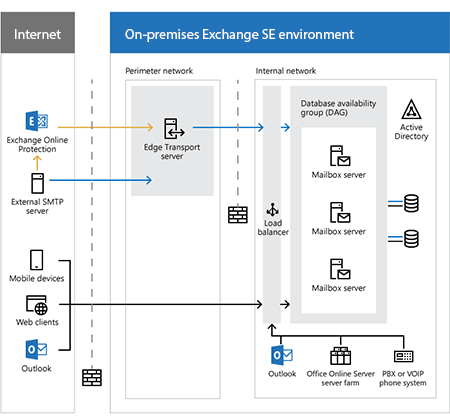
Microsoft Exchange SE Mailbox and Edge Transport servers and management utilities need Standard or Datacenter editions of Windows Server 2019. To administer these Exchange servers from a Windows client you need a current 64-bit version of Windows. (Exchange 2016 can be hosted by Windows Server 2012 R2 and managed with Windows 8.1 or higher.) Progent offers remote or on-premises Microsoft Windows Server 2019 deployment consulting, Windows 11 planning and upgrade consulting, and Windows 10 integration consulting to help your business to update your Exchange environment.
Security and Speed Improvements in Exchange Server SE
Exchange SE is tuned for being hosted on Windows Server Core, which provides the safest environment for Exchange Server SE. You can also implement Microsoft Exchange Server SE on Microsoft Windows Server 2019 with Desktop Experience, although this alternative presents a bigger attack service for malware exploits. Out of the box, Microsoft Exchange Server SE uses Transport Layer Security protocol version 1.2 (TLS 1.2) and replaces outdated hashing algorithms. Several standards organizations mandate the use of TLS 1.2. Another cybersecurity enhancement is the capability in Microsoft Exchange SE to prevent external users from connecting to the Exchange admin center console and the Exchange Management Shell. This means you can require that the administration of Microsoft Exchange SE can occur exclusively from inside the security perimeter of your system.
For improved performance and scale, Exchange SE can utilize as many as 48 processor cores (vs. 24 for Exchange Server 2016) and 256GB of RAM (vs. 192GB for Exchange Server 2016). Suggested minimum in-box memory has been upped to 128GB. The proven search technology used by Exchange Online has been brought to Microsoft Exchange Server SE for enhanced search performance and quicker database failovers, allow bigger files for indexing, and streamline management. Microsoft Exchange Server SE also supports bigger disk drives. To counter the longer latency associated with high-density rotating disks, the new MCDB technology of Exchange Server SE enables you to set up solid state disk (SSD) caching when you implement Database Availability Groups (DAGs). Based on technology developed for Microsoft Exchange Online, MCDB can dramatically improve the quality of the end user experience. Performance is also increased by changes in Exchange SE algorithms that make more RAM available for caching live database copies. These enhancements in Microsoft Exchange Server SE make it practical to scale each server to support additional users, deploy larger drives, and increase the responsiveness of common end-user operations.
Enhancements for Exchange Server SE Clients
Exchange SE can be used with Outlook 2013, 2016 and 2019. Enhancements to the client experience include the Do-Not-Forward function that allows only a meeting's organizer to create invitations other attendees. Out-of-Office options have also been expanded. In addition, a Remove-CalendarEvents cmdlet allows administrators to remove events organized by a worker who no longer works for the business.
Microsoft Cloud Voicemail for Exchange Server SE
Exchange SE does not provide the UM services incorporated in prior releases of Exchange. Unified Messaging services include voicemail and auto attendant. Microsoft Skype for Business 2019 depends on Cloud Voicemail Service for voice messaging functions for Microsoft Exchange SE mailboxes. (Skype for Business 2019 continues to support Exchange Unified Messaging services for Exchange 2013 and Exchange Server 2016.) Microsoft recommends that organizations upgrading to Exchange Server SE adopt Skype for Business Server 2019 and use Microsoft Cloud Voicemail Service. Microsoft Exchange SE and Skype for Business 2019 can be deployed in a hybrid environment with a mix of Exchange SE and cloud-hosted Exchange Online mailboxes so that both on-premises Server SE clients and Microsoft Exchange Online cloud users have full access to advanced voice messaging features.
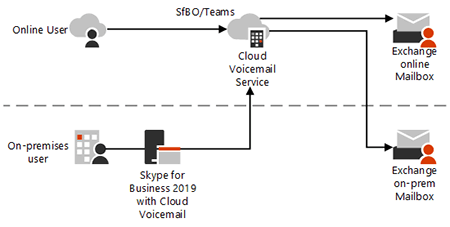
This hybrid voice messaging environment offers voicemail answering and deposit; voice-to-text and text-to-voice transcription; voice mail access through either Microsoft Outlook or Skype for Business; voicemail management through the Microsoft 365 portal; and hybrid support for Exchange mailboxes on premises or cloud resident. Administration is made easier because of a uniform collection of management utilities for both Microsoft Exchange SE and Microsoft Exchange Online mailboxes. Progent can help you to follow leading practices to configure a hybrid topology that enables all your Exchange users to access the Microsoft Cloud Voicemail service.
How Progent Can Help You to Configure and Maintain Exchange SE
Microsoft Exchange Server 2003 has reached end of life (EOL). Exchange Server 2007 and Exchange 2010 have become unsupported legacy platforms. Exchange SE, Windows 2019, Microsoft Skype for Business 2019, and SharePoint Server 2019 have all been revamped with Microsoft's proven cloud environment and optimized for hybrid network architectures. Given this situation, it is prudent to think about updating your messaging and groupware solutions. Progent's Microsoft-certified consultants can assist your business to evaluate the strategic advantages and technical challenges associated with migrating to Exchange and other modern solutions; determine whether an onsite, cloud, or hybrid network model makes sense for your business; design and document a migration plan that makes efficient use of your current resources; and carry out an upgrade from your existing Exchange deployment to a current email ecosystem based on Microsoft Exchange SE.
Progent's Microsoft-certified consultants can help organizations of all sizes to follow leading practices for planning and carrying out a cost-effective migration to Exchange Server SE from Exchange 2016, Exchange 2013, Exchange 2010, Exchange 2007, or Exchange 2003. Progent offers a wide array of remote and on-premises services such as process planning assessment; network topology documentation; setting up Microsoft Windows Server Core to run Exchange Server SE; implementing Microsoft Skype for Business 2019 and Cloud Voicemail Service; diagramming the network schema, domain, and forest for Exchange Server SE; designing and implementing DAGs and HLB for high availability (HA) and fast recovery; deployment DirSync; tuning your firewalls, creating SSL certs and resolving SSL issues; configuring Internet Information Services (IIS); creating PowerShell scripts; and verifying email flow.
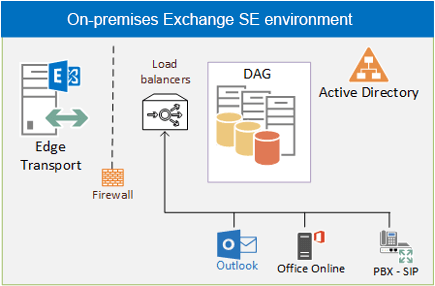
Progent's certified Microsoft Windows Server experts, Microsoft Skype for Business specialists, SharePoint 2019 programming experts and Microsoft 365 integration consultants can assist your business to create modern, integrated collaboration solutions based on Microsoft Exchange SE. To support mobile devices with Microsoft Exchange SE, Progent can provide Apple iOS consulting and Google Android phone expertise. Progent's load balancing consultants are experienced in implementing and troubleshooting cost-effective solutions from leading providers like Barracuda, Cisco, NetScaler, Coyote Point/Fortinet, and NGINX.
Progent's disaster recovery/business continuity planning consultants can assist your business to design, deploy and test a disaster recovery/business continuity strategy for Microsoft Exchange SE based on multiple physical data centers or a mix of physical and cloud-based resources. Progent's ISSAP and GIAC certified cybersecurity experts can design and configure company-wide mail policies that comply with industry requirements and government mandates. Progent's Cisco CCIE-certified network infrastructure engineers can help you to design, implement and debug an efficient, secure, and robust network infrastructure for your Microsoft Exchange Server SE environment. Progent has over 20 years of experience working with Microsoft's Exchange platform and can guide you how to adhere to industry best practices as you proceed through the critical phases of Exchange migration including coexistence, proof of concept, mailbox migration, legacy technology decommissioning, troubleshooting, training, and tuning.
Microsoft 365 Integration with On-premises Exchange
 Microsoft has made a strong effort to enable seamless hybrid ecosystems that combine Microsoft 365 and on-premises Exchange deployments. This allows you to have specific mailboxes located on your on-premises datacenter and other mailboxes resident on Microsoft 365. Progent's certified Exchange consultants can assist your organization with any facet of planning, implementing and debugging your hybrid Exchange network. Progent's Exchange consultants can deliver occasional expertise to help you through challenging technical problems and also offer extensive project management outsourcing or co-sourcing to ensure your hybrid Exchange initiative is completed on schedule and on budget. For details about Progent's consulting services for integrating Microsoft 365 and on-premises Exchange systems, go to Microsoft 365 integration solutions with on-prem Exchange.
Download Progent's Microsoft Exchange Server SE Migration Expertise Datasheet
To read or download a datasheet about Progent's migration expertise for Microsoft Exchange Server SE, click:
Progent's Exchange SE Migration Expertise Datasheet. (PDF - 101 KB)
To get in touch with Progent about professional support for Exchange Server, phone
An index of content::
Progent's professionals offer experience in multiple disciplines relevant to mobile networking such as system architecture, Activesync, wireless security, mobile email, Windows Mobile, Research in Motion Blackberry, and mobile software development. Progent's Microsoft and Cisco certified experts can save your organization time and money by using their wireless expertise to show you how to select and configure wireless networking technologies that fit the needs of your business. Progent can also optimize your IT architecture so that mobile appliances work better.
Select Topic: