Microsoft-certified Consultants
SQL Server 2019 Consulting:
Planning, Deployment, Application Development, Troubleshooting
 Microsoft SQL Server 2019 is a modern, on-premises version of Microsoft's flagship database system. The headline enhancement is the integration of Microsoft SQL Server 2019 with Spark, Hadoop Distributed File System, and additional Linux-based big data technologies to support Big Data Clusters. The Big Data Cluster supports massively scaled AI tasks on the data resident in HDFS and Microsoft SQL Server 2019 storage pools. You can implement Big Data Clusters as containers in on-premises Kubernetes clusters, like AKS on Azure Stack, or in any cloud with a managed Kubernetes service such as Microsoft Azure Kubernetes Service.
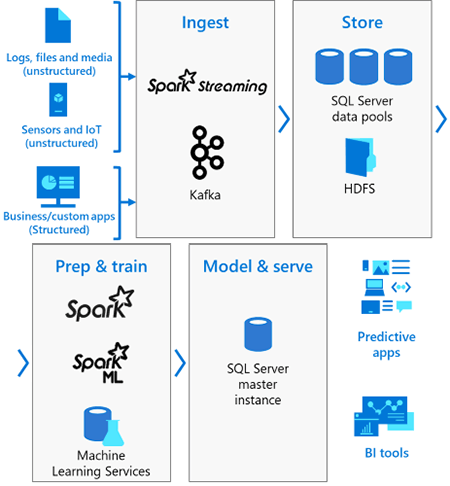
Microsoft SQL 2019 also delivers enhancements in the core SQL Server database technology like feature parity on Linux machines. Additional important enhancements impact SQL Server Analysis Services and SQL Server Reporting Services (SSRS).
Since Microsoft SQL Server 2008 and SQL Server 2008 R2 have reached end of support (EOS) status, moving to a modern version of Microsoft SQL Server is a priority for organizations worried about cybersecurity, manageability, and productivity. Progent has two decades of background designing, implementing, tuning, and debugging SQL Server solutions and can help companies of any size to perform a cost-effective migration to Microsoft SQL Server 2019. Progent's Microsoft-certified SQL Server experts can help you to assess the benefits for transitioning to SQL Server 2019 from an older version of SQL Server and Progent offers fast remote or on-premises access to experts in system architecture, software programming, DBA services, and cybersecurity. Progent can help your business to configure Microsoft SQL Server 2019 on premises, in the cloud, or in a hybrid on-prem/cloud network model.
You can engage Progent's experts on an occasional basis for tasks like system architecture guidance or troubleshooting or you can get comprehensive project management support to make sure your Microsoft SQL Server 2019 migration is completed on schedule and on budget. Progent offers the help of certified data security consultants, disaster recovery preparedness consultants, and database software designers and programmers to make sure your Microsoft SQL Server 2019 environment provides maximum return on investment.
Progent's Microsoft-certified IT experts can also assist your business to set up SQL Server 2019 to operate with additional Microsoft products and services by offering support that includes Microsoft Windows Server 2019 integration consulting, Windows Hyper-V planning and integration consulting, Exchange Server 2019 integration expertise, SharePoint 2019 design and deployment consulting, hybrid configuration with Microsoft Azure cloud services, Skype for Business configuration consulting services, Dynamics GP custom reporting consulting services, and Microsoft System Center Operations Manager (SCOM) consulting.
Progent's seasoned application programmers can assist you to plan, create, validate, deploy, and debug apps that use SQL Server 2019 databases and Progent offers guidance in data modeling, OLTP, Data Warehousing, Data Mining, ETL, tuning, fault tolerance, backup/recovery, analytics, and integration support for Amazon Marketplace Web Service. To learn more about Progent's SQL Server development and troubleshooting services, refer to SQL Server software programming services.
Microsoft SQL Server 2019 Versions
SQL Server 2019 is available in five basic editions distinguished by price, performance, scale and licensing rules. Progent can help you decide which editions make sense for your needs, and Progent can also help you simplify license management.
SQL Server 2019 Enterprise is the high-end edition of SQL Server 2019 and is intended for critical business applications requiring the most advanced levels of scale, reliability, and performance. Compute power and memory supported per database are bound only by the OS maximum, the amount of VMs supported is unlimited, and relational database size can be up to 524 PB. HA capabilities offered only on the Enterprise edition of Microsoft SQL Server 2019 include Always On availability groups for collective failover, online page and file restore, online indexing, resumable online index rebuilds, fast recovery, and hot add memory and compute. Expandability and performance functions exclusive to the Enterprise version of SQL Server 2019 include in-RAM database, partitioned table parallelism, automatic tuning, batch mode adaptive joins plus row mode memory grant feedback. The Enterprise version of SQL Server 2019 also offers a richer collection of data warehousing services, Master Data Services and Advanced Integration Services than other versions.
SQL Server 2019 Developer version is basically identical to the Enterprise version, but is licensed for use only for development and testing. The Developerversion is not licensed for use in a production server. Microsoft SQL Server 2019 Developer allows only one client for SQL Server Distributed Replay.
SQL Server 2019 Standard edition is designed for departments and small businesses who require an entry-level, low-overhead platform for information management and BI. SQL Server 2019 Standard edition supports all the security functions of SQL Server 2019 Enterprise, but compute scale is restricted to the lesser of 4 sockets or two dozen cores. For each instance of SQL Server Database Engine, the most RAM for buffer pool is 128 GB, and max memory-optimized data size is 32 GB. Unlike the Enterprise edition, the Standard version of SQL Server 2019 does not include advanced R and Python integration and does not include Machine Learning Services, but includes the other development functions and the management tools available with the Enterprise edition. Advanced features such as accelerated database recovery and Big Data Clusters are now included with the Standard version.
Microsoft SQL Server 2019 Web version is an inexpensive option designed for web hosting companies. Compute capacity is restricted to the smaller of 4 sockets or 16 cores, max buffer pool RAM is 64 MB, and maximum memory is 64 GB. Unlike the Standard edition of SQL Server 2019, Microsoft SQL Server 2019 Web edition does not include Always On failover cluster instances, hybrid backup, or accelerated database recovery. The Web edition also does not offer transparent database or backup encryption. You can profile SQL Server Web with Microsoft SQL Server Enterprise or SQL Server Standard editions, and SQL Server Web comes with the other management features included with the Standard edition. Data warehousing, tabular and multidimensional models, Business Intelligence Services, and some Reporting Services are not included.
SQL Server 2019 Express, offered in a few releases, is a no-cost entry-level edition of Microsoft SQL Server intended for learning or for creating desktop, bare-bones-server, and client applications that do not require an industrial-strength DBMS. Compute capacity is limited to the lesser of 1 socket or four cores, max buffer pool memory is 1.41 MB, and top RAM-optimized data size is 352 MB. If applications created with SQL Server 2019 Express grow to require more capacity or additional functionality, you can migrate seamlessly to more powerful versions of SQL Server. SQL Server 2019 Express with Advanced Services includes Basic R and SQL Graph services, the distributed replay management utility, and SQL Server Data Tools (SSDT). SQL Server 2019 Express with Advanced Services can also support a SSRS database. SQL Server Express LocalDB is a trimmed down version of Express that operates in user mode and can be deployed without setup and with virtually no prerequisites. The LocalDB edition of Express shares the programmability features of other Express releases but does not support in-memory OLTP.
Components of SQL Server 2019
The SQL Server 2019 Installation Wizard allows you to select which of the SQL Server components you wish to activate in your installation. These elements include:
Database Engine
The Database Engine is the heart of SQL Server's services for processing, storing, and protecting data. The Database Engine is used for replication, search, tools for managing relational data, integrating in-database analytics, integrating PolyBase for working with external data sources like Hadoop, and Machine Learning Services for processing SQL Server 2019's relational data with Python and R scripts.
Analysis Services
SQL SQL Server Analysis Services is an OLAP and data mining toolset for extracting useful information from data dispersed over separate databases or contained in various files or tables.
SSRS
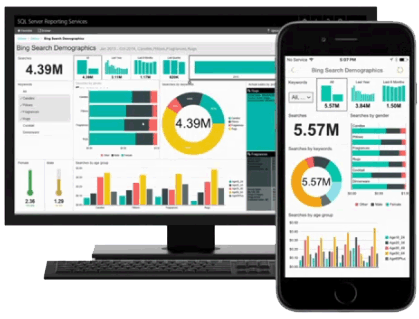
SQL Server Reporting Services (SSRS) offers a set of on-premises utilities and services that allow organizations to build, share, and manage tabular, matrix, graphical, and unstructured reports, both mobile and paginated. You can build responsive-design mobile reports with Microsoft's Mobile Report Publisher app and use native Power BI apps for handheld endpoints to view the data processed in SQL Server Reporting Services (SSRS).
Integration Services
Integration Services (SSIS) is a collection of programmable objects and code-less graphical tools for migrating data from multiple sources. ETL processes can be performed on XML data files, text, and relational data silos. These services can be used for duplicating or downloading files, loading data warehouses, cleaning up and mining data, and controlling Microsoft SQL Server data and objects.
Master Data Services
Master Data Services is SQL Server's Master Data Management (MDM) solution that enables businesses to build a single view of corporate-wide data, synchronizing data sources to avoid redundancies and versioning data organization models to maintain consistency. A Microsoft Excel add-in allows you to publish the master data set throughout an enterprise.
In-Database Machine Learning Services
Microsoft SQL Server 2019 Machine Learning Services enables you to run Python and R scripts with relational data without transferring data out of SQL Server or over the network. The open-source Microsoft Python and R packages can be used to train and deploy machine learning models.
New and Improved Features of Microsoft SQL Server 2019
The most prominent new feature for Microsoft SQL Server 2019 is Big Data Clusters, which allows you to analyze big data from Transact-SQL or Spark for AI solutions. Additional new or improved features impact key areas including the SQL Server Database Engine, feature parity between SQL Server on Linux and SQL Server on Windows, SSAS, and SQL Server Reporting Services.
Big Data Clusters
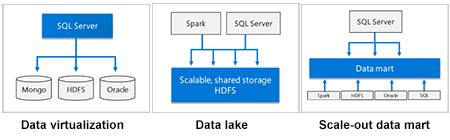
trusted execution environment Server 2019 introduces the Big Data Cluster, a cluster of Linux containers orchestrated by Kubernetes. The Big Data Cluster enables you to implement and use massively scalable clusters in connected SQL Server, Spark, and Hadoop Distributed File System (HDFS) containers orchestrated by Kubernetes. Since these elements can run concurrently, The Big Data Clusters technology permits you to analyze big data from either Microsoft Transact-SQL or Spark and makes it easy to combine and process your SQL Server relational data with unstructured big data. Deployment models include data virtualization for processing outside data silos without moving or replicating the data, data lakes made from HDFS pools to house big data, and scale-out data marts to distribute data from various sources across multiple data pool nodes. You can utilize Apache Spark or integrated R, Python, Scala, and Java utilities in SQL Server 2019 for AI jobs on the data deposited in HDFS storage pools.
Additional Enhancements to the SQL Server 2019 Database Engine
Additional improvements to the Microsoft SQL Server 2019 Database Engine cover intelligent databases, the developer experience, security, HA, and Linux and Windows feature parity. Enhancements to the Microsoft SQL Server 2019 Database Engine include:
- Intelligent Query Processing (IQP) increases the performance of your current applications and is turned on by default on the current database compatibility level designation. Enhancements include automatic memory grant correction, batch mode on rowstore, automatic transformation of scalar UDFs into relational expressions, and table variable deferred compilation.
- Enhanced In-Memory Database features leverage hardware advances to improve throughput and expandability with new functions such as hybrid buffer pool, reduced Metadata contention in TempDB, and support for creating snapshots of databases that include memory-optimized filegroups.
- Intelligent performance improvements in Microsoft SQL Server 2019 impact common bottlenecks and provide database setup alternatives to promote more consistent performance across all your workloads. Improvements include optimization for indexes prone to high-concurrency inserts, Query Store plan forcing and unforcing ability for fast forward and static Transact-SQL and API cursors, more granular control for configuring memory limits for resource governance, reduction in incidents of unnecessary recompilations, improved indirect checkpoint scalability, shared latch concurrent updates for Page Free Space, and scheduler worker migration for long-running tasks to achieve more balanced CPU usage.
- Enhancements to the developer environment include partition tables and indexes support for graph tables, support for UTF-8 import and export variable-width character encoding, Microsoft Extensibility SDK for Java, new spatial reference identifiers better aligned with global positioning systems, and more verbose error messages to streamline debugging truncation issues in failed extract, transform, and load (ETL) processes.
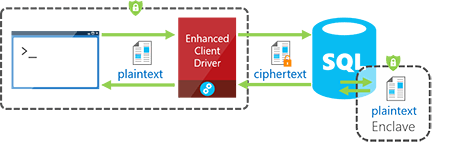
- Cybersecurity improvements include the Always Encrypted feature with secure enclaves functionality, which permits operations on plaintext data within a secure server-side enclave instead of only on on the client side. This avoids transferring data in and out of the database for processes like initial data encryption, thereby improving encryption performance and reliability. Also, certificate management is built into the SQL Server Configuration Manager. This simplifies processes like checking and verifying certificates, managing certificates nearing their expiration, and deploying certificates across machines in Availability Groups. An integrated Data Discovery and Classification feature assists you to categorize and name columns in user tables. This can make it easier to identify where sensitive data resides and to meet data security standards and compliance regulations.
- For enhanced availability, Microsoft SQL Server 2019 expands the maximum number of synchronous replicas in an Availability Group from three to five. You can configure this group of five replicas to have automatic failover within the group. You can deploy one primary replica along with four synchronous secondary replicas. Also, secondary to primary replica R/W connection redirection for Always On Availability Groups allows client application connections to be directed to the primary replica no matter what target server is called for the connections string. This capability brings replica connection redirection for deployments that have no an AG listener as with a multi-subnet configuration in the cloud.
- Microsoft's SQL Server Database Engine recovery process has been re-engineered in SQL Server 2019 with the Accelerated Database Recovery feature. This feature substantially reduces the time needed to finish the recovery process following a failover or other abrupt shut down. SQL Server Accelerated Database Recovery also slashes the time required to complete rollback of canceled long-duration transactions.
- SQL Server on Linux approximates offering feature parity with SQL Server on Windows through the provision of additional SQL Server on Linux functions such as replications services, the MSDTC, AD authentication, Machine Learning Services, PolyBase for running external queries against remote data sources, Change Data Capture (CDC), plus improved scale in TempDB.
Microsoft SQL Server 2019 incorporates new and improved functions for Analysis Services that enhance throughput, resource governance, and client support. These enhancements include calculation groups in tabular models for grouping common measure expressions, query interleaving, many-to-many relationships in tabular models, and the ability to attach a tabular model as an online operation.
Enhancements to SSRS 2019
Enhancements to SQL Server 2019 Reporting Services (SSRS) include:
- Support for Azure SQL Managed Instance (MI) allows you to host a database catalog for SQL Server 2019 Reporting Services (SSRS) in an Azure SQL Managed Instance hosted either in a virtual machine or on-premises. You must use your database credentials for connecting with SQL MI.
- Support for Power BI Premium datasets via Microsoft Report Builder or SQL Server Data Tools (SSDT). You can then publish those reports to SQL Server 2019 Reporting Services by utilizing SQL Server 2019 Analysis Services connectivity.
- Azure AD Application Proxy support eliminates the need to manage your own web application proxy to permit safe access through the web or mobile apps.
- Microsoft SQL Server 2019 works with Transparent Database Encryption for the SQL Server 2019 Reporting Services (SSRS) catalog database for Enterprise and Standard versions of SQL Server.
Progent's Microsoft-certified experts can provide online and on-premises expertise to assist your business to design, implement, manage, optimize, and troubleshoot your SQL Server 2019 deployment. Progent's consultants can assist your organization to assess the benefits of migrating to Microsoft SQL Server 2019 and can help you to design an appropriate architecture for an on-premises or hybrid onsite/cloud network model.
Progent can help your company to migrate your data and apps, set up pilot environments to validate SQL Server 2019's capability to run your business-critical applications, streamline management, create and implement an enterprise-wide cybersecurity plan that meets government and industry mandates, accommodate mobile endpoints, and create a disaster preparedness/business continuity strategy that incorporates the advanced HA technologies integrated into SQL Server 2019.
Expertise available from Progent for SQL Server 2019 include:
- Project Management: Progent can provide project management and co-management services to help you to adhere to best practices to make sure your Microsoft SQL Server 2019 project is successfully completed on schedule and within budget. Project offers the services of IT experts to help with any phase of project management including requirements identification, preparedness evaluation, solution design, migration planning, building test systems, implementation, tuning, documentation, education, management, and as-needed remote or on-premises advice and troubleshooting.
- Database Migration: Progent's seasoned Database Administration consultants can provide expertisefor all releases of SQL Server, including end-of-support (EOS) releases like SQL Server 2008 R2. Progent also offers Oracle expertise, MySQL software design and development, and Microsoft Access consulting. Progent has two decades of experience delivering database solutions and can assist your organization to port your databases and applications to SQL Server 2019 rapidly and affordably.
- Integration with Other Microsoft Products: Microsoft's vast catalog of enterprise applications, operating systems, development environments, management utilities, and IT services depend on Microsoft SQL Server as their underlying database engine. Progent's Microsoft-certified consultants can help you to deploy SQL Server 2019 seamlessly with other Microsoft products by offering consulting services that include Microsoft Windows Server 2019 upgrade consulting, SharePoint Server 2019 application development, Power BI reporting expertise, Exchange Server 2019 migration consulting and Microsoft 365 Exchange Online integration solutions, and Active Directory planning and troubleshooting.
- Business Intelligence and Reporting: Progent's business intelligence (BI) and reporting experts can help your company to utilize Microsoft's BI stack to build and share BI reports that can be shared securely from any endpoint. Progent can help you create PowerPivot models and use SQL SSAS 2019 to extract insights from tabular databases. Progent's Power BI consultants can help your organization to communicate with Power BI datasets using Microsoft Report Builder or SQL Server Data Tools and post reports to SSRS 2019 by using SSAS 2019 connections. Progent's BI consultants can also help you to integrate SQL Server 2019 with third-party BI reporting platforms such as or migrate from legacy reporting products like FRx.
- Network Infrastructure: Progent's Cisco-certified CCIE networking experts can help you to plan, deploy, manage, and protect a resilient and high-performance network infrastructure for your Microsoft SQL Server 2019 environment. Progent can help your business design and implement an efficient solution for any network model including onsite or hybrid.
- Security and Compliance: Progent's cybersecurity and compliance experts have been awarded advanced data security certifications including CISA, CISSP and CRISC. Progent offers organizations of all sizes a variety of security services including vulnerability assessment, improvements, response, and monitoring services to defend against known and new cyber attacks such as ransomware and to verify compliance with regulatory and industry mandates.
- Virtualization Expertise: Progent can help you to plan and implement a cost-effective and easy-to-manage virtual environment for SQL Server 2019 and can provide the expertise of certified Windows Hyper-V consultants, VMware vSphere and vCloud experts, VMware NSX-certified consultants, and Citrix XenServer consulting experts to assist your business to configure and manage a virtualized ecosystem.
- ProSight Remote Monitoring and Management Services: Progent provides a selection of affordable, flat-rate managed services intended to enable small and medium-size businesses to utilize the same advanced IT solutions used by some of the world's leading enterprises. The ProSight portfolio of network management outsourcing services addresses all key facets of modern networking such as email protection, threat defense based on machine leaning, automated backup/recovery, network infrastructure monitoring and management, VM hosting, and IT asset documentation management.
- Disaster Preparedness/Business Continuity Preparedness: Progent's disaster preparedness consultants can assist your company to develop and test a disaster recovery strategy that incorporates Microsoft SQL Server 2019's high-availability technology to maximize network resilience and shorten recovery time for business-critical applications. Progent's business continuity planning experts can assist you to create and validate a detailed strategy to keep your essential business processes operating in the event of a catastrophe. The business continuity plan deals with IT infrastructure but also covers preparation for issues such as alternative alert technologies and procedures, short-term office space, and regulatory requirements for reporting.
- Remote Consulting and Debugging: Progent has two decades of experience delivering advanced consulting, application programming, and debugging services online. Using remote IT support helps you to minimize the expense and duration of network disruptions. Progent has successfully delivered online network support to businesses in each state in the U.S. See Progent's customer testimonials.) Progent can also provide on-site support in most metropolitan areas throughout the United States and Canada.
To find out more about how Progent can assist you with Microsoft SQL Server 2019 planning, administration, troubleshooting, or application development, call
If you need immediate remote help from a Microsoft-certified consultant, visit Progent's Online Network Support.
Learn more about Progent's Consulting Services for Microsoft .NET Server Platforms.
Select Topic: