Cloud Integration Support
Google Cloud Platform Solutions:
System Design, Integration, and Troubleshooting
 Google Cloud Platform (GCP) is a leading suite of cloud services that provides Infrastructure-as-a-Service and Platform-as-a-Service features. Google Cloud's share of the public cloud sector is behind only Amazon AWS and Azure. Like these competitors, Google Cloud uses the same extensive network infrastructure that supports its most popular online applications. For Google, these include Google Search and YouTube. The Google cloud portfolio has more than 100 products that cover compute, storage, database management, networking, analytics, Big Data, machine learning, artificial intelligence, access management, cybersecurity, Internet of Things (IoT), and centralized tools.

Progent offers expertise assisting businesses from small offices to enterprises to design, configure, test, administer, and troubleshoot IT ecosystems based on a variety of network models including on-premises data centers, private clouds, one or more public clouds, or a hybrid combination of onsite and cloud-based resources. Progent offers quick online or onsite access to seasoned consultants to help you to assess the potential benefits and limitations of possible network models and compare the services and cost of Google Cloud vs. alternative public cloud vendors.
Progent's Microsoft, Linux, and Cisco consultants can help you to expand your current IT resources with the Google Cloud Platform, and Progent's database consultants can show you how to make your business-critical applications cloud ready so they can take full advantage of GCP products and services. Progent can help you to set up virtual machines on Google Cloud Compute Engine, design an efficient storage solution with Google Cloud Storage services, and simplify identity management with Google Cloud Identity. Progent can also assist you to use GCP's unified tools to administer and track your Google Cloud ecosystem so it continually delivers top return on investment.
Major Services Available for the Google Cloud
Google Cloud Platform has more than 100 IaaS and PaaS services covering virtually all facets of IT including processing, storage, database management, networking, administration, cybersecurity, web, mobile computing, and application development. Google Cloud services are offered on a subscription basis. Like other public cloud services, you pay for the resources you use. Important Google Cloud products and services for which Progent offers expert consulting and technical support include:
 Compute Engine is an IaaS service for running Windows and Linux virtual machines in the cloud, comparable to Amazon EC2 or Azure Virtual Machines. Compute Engine VMs have seamless access to Google Cloud block storage and state-of-the-art network infrastructure. GCP Compute Engine offers three types of virtual machines in either standard or custom machine sizes. Google's N2 type VM is value priced and intended for common applications like web hosting, business applications, and databases. The C2 type virtual machine provides as many as 60 virtual CPUs (vCPUs) for compute-intensive applications such as electronic computer-aided design and simulations. Google Cloud's M2 class virtual machine includes up to 11.5 TB of memory for memory-intensive applications like in-memory databases or time-critical analytics. GCP's sole-tenant node product provides a physical Compute Engine machine dedicated to your exclusive use.
Important benefits of the Google Compute Engine include live virtual machine migration, which lets you keep virtual machines running even during scheduled maintenance, and preemptible VMs, low-cost virtual machine compute instances which last for a max of 24 hours and are intended for executing batch jobs that can be paused and continued intermittently without compromising productivity.
Additional available benefits for GCP Compute Engine include:
- Always-encrypted local SSD block storage for enhanced speed and security
- Graphics Processing Unit that can be added to VM instances for processor-intense applications like machine learning and 3D graphics
- Global load balancing for optimizing performance and uptime at low cost
- Google Kubernetes Engine for orchestrating containers on Compute Engine virtual machines
 Google Cloud Storage provides object storage that scales to exabytes of data. Data held in Google Cloud Cloud Storage are logically organized in containers known as buckets. GCP offers four classes of cloud storage, differentiated and priced according to the object's expected longevity and its hot/cold ratio. As you progress through the storage classes from Standard to Archive, access expense go up, at-rest costs decrease, and required minimum storage time increases. Google's storage classes make it possible to control costs by designing the appropriate cost/performance profile for your environment, and Google Cloud's Object Life Cycle Management tool allows you to program the progression of storage objects from high-access to low-access types over time. All storage types share worldwide accessibility, unlimited storage (but a size limit of 5 TB for individual objects, no minimum object size, low latency, optional geo-redundancy, and a shared set of cloud security and management utilities. One API applies to all storage classes.
Standard Storage is the default type and is suited for so-called "hot" storage used frequently or stored only for short periods. There is no minimum storage time. For the best performance and least network fees, Standard Storage data should be kept in the same geographical region as the VM instances or the container clusters that use the objects. Standard Storage offers the highest average availability for regions, dual-regions, and multi-regions. Nearline Storage is a low-priced storage option intended for data accessed only occasionally, preferably around once per month. Examples of appropriate use cases are periodic backup and archiving. At-rest costs are less than with Google Cloud's Standard Storage, but data access is more expensive, availability is marginally lower, and storage duration is a minimum of 30 days.
Coldline Storage provides rock bottom storage pricing for at-rest data and is designed for situations where objects are accessed no more frequently than once every 90 days Minimum duration is three months, availability is slightly less than with GCP's Standard and Nearline Storage services, and data access pricing is relatively high. Google's Archive Storage, which offers the lowest at-rest storage costs but has a minimum duration of one year, is the best storage service for objects held exclusively for backup or archive scenarios. Data access costs for Archive Storage are the highest of any Google storage type.
Cloud Storage Encryption
Google Cloud Storage always encrypts data on the server end prior to placing it on disk. Added to this routine encryption process, you can select other options to encrypt your data. GCP offers two server-side encryption options that allow objects to be encrypted after making it to Google Cloud Storage but before the data is written to disk. The Customer-supplied encryption keys enables you to create and control your own encryption keys. Google Cloud's Customer-managed encryption keys alternative allows you to create and control your encryption keys via Google's Cloud Key Management Service. Both these server-side encryption services create an extra layer of encryption above GCP's standard Cloud Storage encryption.
In case you perform client-side encryption prior transporting your data to GCP Cloud Storage, your encrypted data will also be subject to Google's server-side encryption.
 Google Cloud Identity and Access Management (IAM) is Google's centralized system for controlling access to network resources and granting permissions for users and services to access network resources for a specified period of time. Examples of GCP resources are Compute Engine instances and Cloud Storage buckets. Centralized tools give admins the ability to control access rights for all services available within Google Cloud. Google Cloud Identity and Access Management offers high precision in creating policies to grant groups and users permissions to access only required resources while preventing access to unnecessary resources.
With Google Cloud IAM, policies are made up of roles; roles are made up of permissions; and permissions are associated with resources. Users or groups are assigned to policies, and through the policy they are given access rights to the specific resources their roles provide. As an example of Google Cloud Identity and Access Management's role granularity, the Google Cloud Pub/Sub service can be accessed with a variety of usage right determined by whether a user or group has been assigned the role of Owner, Editor, Viewer, Publisher, or Subscriber.
Cloud IAM policies are hierarchy-based, cascading downward from the organization to projects and then to resources. You can define organization-wide policies, tune them as appropriate for a specific project, and tune them further for a specific resource. You can assign access policies to individual resources, to a project, or at the organizational level. Policies you assign to an organization flow down to projects within the organization and then to resources within projects.
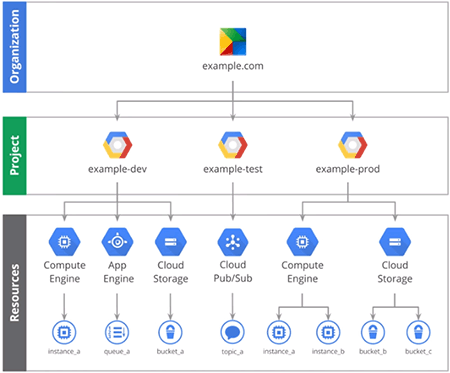
Additional refinement in managing resource access rights is offered by allowing administrators to include contextual attributes such as device security status, IP address, resource type, and time. You can control access rights via the GUI interface of Google's web-based Cloud Console tool, via automation by using Cloud IAM methods, or through Google's gcloud command-line feature. Cloud IAM automatically maintains a complete audit trail to facilitate regulatory compliance.
Google Cloud Identity and Access Management is provided at no extra cost to all GCP licensees.
 Google Kubernetes Engine (GKE is a container service for running containerized applications. Kubernetes was initially created by Google to automate container orchestration and was made available as open source at the end of 2014. Since that time Kubernetes has grown to be the most popular platform for managing containerized workloads.
Google Kubernetes Engine is powered by Google's Container-Optimized OS and runs Certified Kubernetes, allowing workload compatibility with other Kubernetes products spanning cloud and on-premises networks. To streamline development, prebuilt open-source deployment templates for commercial apps are offered on Google Cloud Marketplace.
The Migrate for Anthos tool, available for free with GKE, enables you to migrate and port your workloads directly from your current environment into GKE containers. These workloads can be physical servers and virtual machines situated onsite, in Google's Compute Engine, or in third-party clouds. GKE allows pod and cluster autoscaling for continuous analysis of the CPU and RAM usage of pods and for dynamically adjusting CPU and RAM requests across multiple node pools.
Other capabilities of GKE include preemptible virtual machines, persistent disks, always-encrypted local SSD block storage, global load balancing to optimize speed and uptime, support for both Windows Server and Linux nodes, the ability to run stateless serverless containers via the Google Cloud Run service, and usage metering for granular visibility into your Kubernetes clusters.
Google Kubernetes Engine complies with HIPAA and PCI DSS 3.1. For enhanced cybersecurity, GKE Sandbox provides an additional layer of defense between containerized Google Kubernetes Engine workloads. GKE clusters offer native support for Kubernetes Network Policy to filter traffic via pod-level firewall policies. Private clusters in GKE can be limited to a private or public endpoint accessible only to specified address ranges.
GKE charges for each GCP Compute Engine instance in a cluster. Use of GCP Compute Engine resources is billed on a per-second basis with a one-minute minimum cost.
 Cloud AI Building Blocks enable software developers, even with little or no machine learning (ML) backgrounds, to incorporate Google's advanced AI capabilities into their applications. Core capabilities cover sight, language, and conversation. By using Google's APIs, you can take advantage of Google's out-of-the-box AI models rather than having to deal with developing your own datasets from scratch and training and validating your own models. As Google's library of pre-trained models expands, you can immediately add state-of-the-art AI technology to your apps. Also, Google Cloud AutoML products give you the tools required to train, validate and deploy your own domain-specific machine learning models. Developers can use any Google Cloud AI Building Block individually or in combination with other AI tools depending on your requirements.
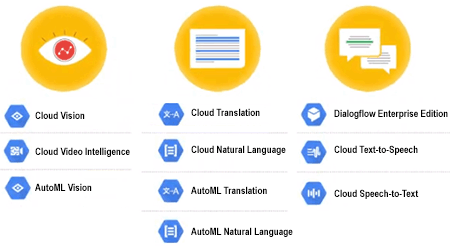
For AI-enhanced imaging, Google GCP Cloud AI Building Blocks offer the AutoML Vision and Vision API products that allow you to extract insights from your images. Both services support REST and RPC APIs and allow your app to discern objects and their location inside the image. AutoML Vision simplifies the training process for your custom machine learning (ML) models by providing an easy-to-use graphical interface. Once you optimize your models for accuracy, speed and size, you can export them to the Google GCP Cloud or to a variety of edge devices.
Google Cloud's Vision API provides integration with Google's pre-trained machine learning models. You can quickly classify images using Google's extensive collections of pre-trained labels. Vision API uses OCR tools to detect text, in more than 50 languages, contained within images. Combined with Google's Document Understanding AI feature, you can benefit from the same machine learning technology that powers Google Search to extract actionable insights from volumes of unstructured documents. You can discern web objects and pages, distinguish a face from other items and detect facial characteristics, and recognize brand logos and popular landmarks. You can also recognize adult or violent content within images.
Google Cloud's AutoML Video Intelligence and Video Intelligence API products, which provide a similarly wide array of features as the Vision services, make it easy to mine value from video files.
Language Services
Language is Google's strong suit, and Google's stack of AI Building Blocks understandably includes a rich arsenal of services. Google GCP language services include:
- Cloud Translation API
This service enables you to enrich web sites and applications with real-time translation features powered by Google's neural translation technology. Google Cloud offers a Basic and an Advanced release of Google's Translation API. Both options use Google's pre-trained, generalized model and feature automatic language detection, a REST API, seamless HTML support, and the capability to translate between over 100 language pairs. The Advanced version of Google Cloud Translation API adds an extensible glossary to preserve your branding in translated copy, batch translation capability in Google Cloud Storage, the ability to use custom AutoML Translation models, and a built-in gRPC API. The Cloud Translation service charges per character. - AutoML Translation
This machine learning platform enables developers to build a custom translation model by training it with your own dataset. The dataset is made of matching pairs of sentences in the source and target languages. AutoML Translation applies statistical analysis to the items from your dataset to train the model, tests it, and scores its accuracy. After you assess the effectiveness of your model, you can modify your dataset and train a new model repeatedly until you are happy with the outcome. You can build your own translation models in more than 50 language pairs. Costs for using AutoML Translation are based on the hours of training required and the volume of characters you submit for translation. - Cloud Natural Language API
Google's Natural Language API marshals a library of pre-built machine learning models to help you to understand the meaning and structure of documents. A content classification model discerns content categories in a document, such as civil engineering, finance, or sports; an entity analysis model identifies and tags common known entities referred to in the document, like country, company, or athlete); a sentiment analysis model assesses the author's attitude suggested by the document and the strength of emotion; an entity sentiment analysis model combines entity and sentiment analysis by detecting familiar entities in a document and determining the attitude and the magnitude of emotion demonstrated in relation to those entities; a syntactic analysis model exposes structural organization by breaking text up into sentences and words, which are further broken down into parts of speech and roots. Each API detects the language of the target text if it is not specified. The's Natural Language API is a REST API and uses JSON requests and responses. Text to be analyzed can be included in the request or held in Google Cloud Storage. - AutoML Natural Language
GCP's AutoML Natural Language service enables you to build and refine your own Natural Language models for classification, entity extraction, and sentiment analysis. As an example, a sentiment analysis model designed by an airline could learn that a mention of lost baggage in a tweet reflects a negative rather than positive sentiment. GCP's AutoML Natural Language product makes it easy to build a custom dataset, use the dataset to train a model, test the model, and tune your dataset until your model is suitable to deploy. - Dialogflow
GCP's Dialogflow is a platform that uses the same natural language technology that powers Google Assistant to help you to create a conversational interface so your product can interact with your customers by voice. You can add this technology to a mobile app, website, voice response system, or any other scenario that could be improved with natural voice interaction. Google's Dialogflow platform can analyze text or voice inputs and can reply through text or synthetic speech. Dialogflow can detect a user's meaning and detect pre-defined entities including time, date, and numbers. You can train your Dialogflow agent to identify your own entity types by providing small sample datasets, or you can use over 40 out-of-the-box agents as templates. Commercial editions of Dialogflow are billed according to audio/phone time and the number of characters and queries. - Cloud Text-to-Speech
Google Cloud's Text-to-Speech API converts text or Speech Synthesis Markup Language to high-quality, natural-sounding speech in more than 30 languages and over 180 voices. Cloud Text-to-Speech service works with any application or device able to send REST or gRPC requests. Devices can be phones, PCs, tablets, and IoT devices such as cars, TVs, and speakers. Accepted audio coding formats include mp3, Linear16, and Ogg Opus. You can include Speech Synthesis Markup Language tags to add pauses, numbers, date and time formatting, and other instructions. Cloud Text-to-Speech is priced based on million characters processed. - Speech-to-Text
GCP's Speech-to-Text API gives developers access to leading-edge automatic speech recognition (ASR) technology based on Google's continually refined deep-learning neural network algorithms. Google's Speech-to-Text can translate streaming audio in real time and can be optimized to handle various sampling frequencies associated with phones, video, or voice commands/search. The API works with 120 languages and can identify what language is spoken from a list of as many as four. You can identify a maximum of 5,000 words or phrases that relate to your business, such as brand or stakeholder names. The technology can automatically capitalize proper names and convert spoken numbers into addresses, dates, phone numbers, and currencies. Video transcription includes punctuation, and the speaker diarization feature can differentiate among multiple talkers in a conference. Noise cancellation is included, and for some languages you have the ability to filter out offensive language. Supported encodings include FLAC, AMR, PCMU, and Linear-16. Billing is time based.
If you plan to connect your IT network with Google Cloud Platform (GCP), whether as a cloud-based ecosystem or as a hybrid local/cloud solution, Progent can help you to assess the benefits of GCP compared to competing public clouds or to alternative network architectures. Progent can help you with every stage of a move to GCP including requirements planning, solution architecture, testing, deployment, management automation, performance tuning, license management, disaster recovery preparedness, and cybersecurity review.
Progent can assist you to determine which of your applications are appropriate for GCP and can show you how to make your legacy applications cloud ready. Progent has helped clients evaluate running Google Cloud SQL, using Google Dataproc for on-prem Hadoop, adopting Google Kubernetes Engine as a virtualization substitute, and deploying MongoDB Atlas on GCP vs. on-premises MongoDB. Progent can provide as-needed online consulting support for short-term jobs to help you quickly overcome stubborn technical hurdles or Progent can deliver comprehensive project management consulting services to make sure your Google Cloud integration program is successfully carried out on time and on budget.
Among the most common technical problems businesses face when integrating with Google Cloud or other public cloud is setting up firewalls and VPN connections to give users easy but secure access to cloud resources. Progent can provide the expertise of Cisco-certified CCIE network consultants and firewall specialists for security appliances from major vendors like Cisco, Palo Alto Networks, Barracuda, WatchGuard, and Fortinet to assist you to configure or debug firewalls for accessing Google Cloud Platform. To accommodate mobile computing, Progent's iPhone and iPad management consultants and Android integration experts can help you to configure and administer secure mobile endpoints for your Google Cloud users. Progent can work in concert with your in-house IT team and Google's support engineers to mitigate GCP connectivity issues quickly and affordably.
Popular online consulting services provided by Progent to assist businesses expand their networks with Google Cloud include:
- Check hybrid solution plan for Google Compute Engine VMs and GCP Cloud Storage
- Create and verify virtual machine images for Windows or Linux
- Configure, deploy and debug VPN tunnels for connectivity with GCP
- Design integration solutions for firewalls from Cisco, Palo Alto Networks, Barracuda, WatchGuard, and Fortinet and others
- Configure and debug mobile devices
- Define and implement security policies based on best practices
- Fix IP addressing issues
- Design cost-managed plan for Google Cloud Storage
- Optimize query efficiency on Cloud SQL
- Automate license management
- Resolve certificate problems
An expanding selection of public cloud products and services compete with or complement Google Cloud. For a variety of motives, it is common for enterprises to deploy a network architecture that incorporates multiple public cloud platforms along with on-premises IT assets. Progent can help you to evaluate the relative benefits of top public cloud offerings and can assist you to design, integrate and maintain network ecosystems that incorporate a combination of public and private clouds and local data centers.
Additional leading cloud platforms supported by Progent include:
 Progent's Azure planning and integration experts can help you with any stage of Azure cloud integration including needs analysis, prerequisites evaluation, system architecture, pilot testing, deployment, automated administration, performance tuning, license management, disaster recovery strategies, security policy enforcement, and compliance validation. Progent can assist your IT staff to configure and troubleshoot firewalls and VPN connections so your users can securely connect to Azure-based resources, and Progent's Microsoft-certified consultants can help you set up key Microsoft platforms to work in Azure including Windows Server, Exchange Server, SQL and SharePoint. Progent can also help your organization to set up a hybrid environment that seamlessly combines on-premises datacenters with Azure resources.
 Microsoft has made a strong effort to enable transparent hybrid ecosystems that combine Microsoft 365 and local Exchange. This permits you to have some mailboxes located on your corporate datacenter and other mailboxes resident on Microsoft 365. Progent's Microsoft-certified consultants can assist your organization with any phase of designing, implementing and debugging your hybrid Exchange solution. Progent's Exchange specialists can provide as-needed expertise to help you resolve challenging technical bottlenecks and also can provide comprehensive project management outsourcing or co-sourcing to make sure your hybrid Exchange solution is carried out on time and on budget. For more information about Progent's online consulting support for hybrid Microsoft 365 Exchange and on-prem Exchange systems, refer to Exchange Online integration solutions with on-premises Exchange.
 Progent's Office and Microsoft 365 consultants can assist companies to integrate Office desktop and Microsoft 365 applications such as Excel, Office Word, PowerPoint, Microsoft Outlook, Microsoft Access, Project and OneNote into a cohesive productivity solution that provides quick return on investment and enables improved business outcomes. Progent can help your company to interface Microsoft Office or Microsoft 365 applications with each other and with additional core Microsoft technologies such as SharePoint Server, Exchange Server and Microsoft SQL Server running locally or hosted in the cloud. Progent's consultants can also help you to fix compatibility problems between different releases of Microsoft Office desktop and offers customized online Microsoft Office and Microsoft 365 training to individual users and groups.
 Progent's Amazon AWS cloud planning and integration experts can provide cost-effective online support to help companies of any size to integrate Amazon AWS cloud services such as Elastic Compute Cloud (EC2) for virtual server hosting, Amazon S3 for scalable low-latency storage, and Amazon Glacier for low-cost archival storage. Progent can help your IT team with every aspect of Amazon AWS integration including requirements analysis, readiness evaluation, architectural design, testing, configuration, centralized administration, performance optimization, software license management, disaster recovery solutions, and security and compliance. Progent offers advanced expertise with firewalls and VPN access and can show you how to deploy cloud-based or hybrid environments that seamlessly integrate Amazon AWS cloud services. Progent offers as-needed expertise or Progent can deliver comprehensive project management outsourcing or co-sourcing to help you migrate efficiently to the Amazon AWS cloud platform.
 Amazon Marketplace Web Service is an integrated collection of APIs that enables Amazon sellers to streamline their business processes by automating crucial sales activities including listings, orders, shipments, inbound and outbound fulfillment, and reports. By leveraging Amazon's extensive online ecosystem and automating their sales processes, vendors can broaden their market, reduce their operating costs, accelerate reaction time to customers, and increase their profits. Progent's Amazon Marketplace Web Service (Amazon MWS) consultants can work with your development team and provide programming, workflow integration, project management support, and training to help you cut development time and get to market quickly.
Contact Progent for Google Cloud Platform Integration Expertise
If you need help with any phase of integrating your IT system with Google Cloud Platform or any other public cloud platform, call Progent at
Select Topic: