Cisco Certified Network Consultants
Cisco WiFi 6 and 6E Consulting
From CCIE Premier Experts
Cisco has developed a comprehensive catalog of wireless LAN devices and software tools that enable continual access to data and other resources and to promote collaboration among workers, associates, vendors, and clients. Cisco's wireless product families include Cisco's Small Business, Aironet and Meraki lines of wireless access points, as well as Cisco's Wireless LAN Controller modules and appliances. Progent's certified wireless experts can help businesses of all sizes to utilize Cisco wireless solutions to support the current paradigm of Bring-Your-Own-Device networks by integrating their wired/wireless ecosystems to achieve simplified deployment, consistently high performance, single-point control, enterprise-wide policy enforcement, high availability, and advanced security.
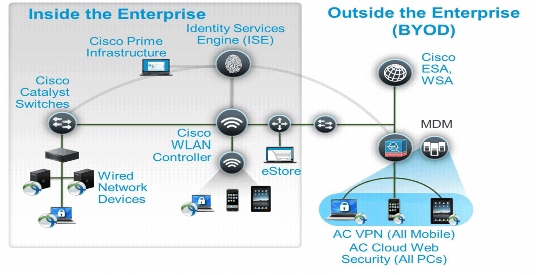
Cisco's Unified Wireless Network architecture can expand to up to 18,000 access points with Layer 3 mobility at local or offsite venues such as business headquarters, university lecture halls, branch offices, and home offices. Cisco's 802.11x APs and controllers are part of Cisco's Unified Wireless Network and are engineered to support the same level of protection, throughput, and manageability for wireless LANs that companies expect in their wired ecosystem. Cisco's architecture includes integrated mobility services like Voice over IP, high-definition IP video, and safe guest connectivity. Cisco's Unified Wireless Network architecture enables companies to build wireless ecosystems that streamline the way they do business and enhance output via a dynamic and collaborative workforce.
Progent's Cisco-certified network infrastructure consulting services can provide online or onsite support to assist you to plan, deploy, maintain, expand, and repair converged wired and wireless network infrastructure of all sizes and for any venue. In addition, Progent offers affordable online and onsite wireless site surveys to help you to plan and install a wireless network with custom-designed AP clusters optimized for your individual office layout, building structure, and intended application.
Small Business, Aironet, Meraki and Catalyst Wireless Access Points
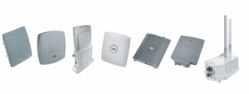 Cisco's Small Business, Aironet, Meraki and Catalyst families of APs enable businesses to converge wired/wireless networks to provide the coverage, density, throughput, protection and ease of management required to support virtually any environment. These APs range from bare bones, single-radio 802.11b/g/n devices with data rates of 300 Mbps designed for small businesses or home offices to 802.11ax access points suitable for handling hundreds of clients per access point and offering sustained throughput in excess of 5 Gbps. Cisco's current line of wireless access points can be combined or clustered to deliver the capacity to handle sites crowded with clients and with high usage rates of video-intense apps.
Cisco Small Business 100, 300 and 500 Series of APs
Cisco's Small Business, Aironet, Meraki and Catalyst families of APs enable businesses to converge wired/wireless networks to provide the coverage, density, throughput, protection and ease of management required to support virtually any environment. These APs range from bare bones, single-radio 802.11b/g/n devices with data rates of 300 Mbps designed for small businesses or home offices to 802.11ax access points suitable for handling hundreds of clients per access point and offering sustained throughput in excess of 5 Gbps. Cisco's current line of wireless access points can be combined or clustered to deliver the capacity to handle sites crowded with clients and with high usage rates of video-intense apps.
Cisco Small Business 100, 300 and 500 Series of APs
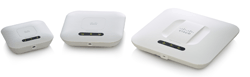 Cisco's Small Business 100, 300 and 500 Series of APs are Linux-based units designed as value-priced wireless APs for small offices. Many versions in Cisco's Small Business family of wireless access points work with Cisco's Single Point Setup technology, which makes it possible to configure, manage and troubleshoot a group of wireless access points from one device via a simple web browser tool. All versions include Power over Ethernet and feature QoS, rogue access point detection, and bridge mode for wirelessly connecting to another network.
Cisco's Small Business WAP121 Access Point is a wallmount, single-radio 2.4GHz unit able to support 16 802.11b/g/n wireless clients, has a Fast Ethernet interface, permits up to 4 access pointss and 40 active clients per cluster, and supports throughput of up to 300 Mbps. Cisco's WAP131 is a desktop dual-band 2.4/5 GHz 802.11a/b/g/n access point that can support 16 wireless clients per radio for up to 32 clients, features a Gigabit Ethernet LAN interface, and delivers throughput of 300 Mbps for each radio. The WAP131 does not support AP clustering. The Cisco WAP150 is an entry-level Wave 1 dual-radio 802.11ac/n access point that includes a 1xGE Power over Ethernet port and can support up to 16 clients from each radio with 867 Mbps throughput for AC clients and 300 Mbps for 802.11n devices. The Cisco Small Business WAP150 allows 4 access points for each cluster.
Cisco's Small Business WAP321 Access Point is a wall-mountable single-band (2.4 or 5 GHz) 802.11n unit that can handle 80 active wireless clients in an 8-AP cluster. The Cisco WAP321 features a Gigabit Ethernet port and can deliver a data rate of 300 Mbps for the selected radio. The Cisco Small Business WAP351 is a dual-band 2.4/5 GHz 802.11n access point with a 5-port Gigabit Ethernet switch and can handle 32 active clients on each radio for up to 64 clients, and deliver a data rate of 300 Mbps per radio. The WAP351 access point does not support clustering. The Cisco WAP361 is a dual-band 2.4/5 GHz Wireless-AC/N wireless access point that includes a 5 x Gb Ethernet LAN switch, can support 32 clients per radio, and offers 867 Mbps throughput for 802.11ac devices and 300 Mbps for 802.11n clients. Cisco's WAP361 supports 8 access points per cluster. Cisco's wall-mountable WAP371 Wireless-AC/N is a dual-band AP that works with 802.11n and the latest 802.11ac IEEE Wi-Fi standard. The WAP371 includes a 10/100/1000 Ethernet interface, can support as many as 32 active clients per radio, and 8 access points for each cluster.
Cisco's Small Business WAP561 Wireless-N Selectable Band wireless access point includes one Gigabit Ethernet LAN interface and dual concurrent radios that deliver 450 Mbps throughput for each radio, can handle 64 devices for each radio, and allow 16 APs per cluster. The Cisco WAP551 is similar to Cisco's WAP 561 but features a single selectable band (2.4 or 5.0 GHz). The Cisco Small Business WAP571 and WAP571E (a weather-proof outside model) are dual-band Wireless-AC/N wireless access points that feature two Gb Ethernet ports with link aggregation (LAG), 3x3 MIMO, and up to 1.9 Gbps throughput with 1300 Mbps over 11ac and 600 Mbps on 11n. Both units support 32 clients on each radio and 16 APs per cluster.

 Cisco's Small Business WAP581 Wireless-AC Dual Radio Wave 2 AP supports the Wi-Fi 5 specification and features 4x4 and 3x3 MU-MIMO to provide 2.8 Gbps data rates at 5 GHz and 0.6 Gbps on the 2.4-GHz radio for an aggregate max throughput of 2.4 Gbps. The Small Business WAP581 has an integrated 2.5G Ethernet LAN interface and a 10/100/1000 Ethernet interface with 802.3at PoE. The WAP581 Wave 2 Wi-Fi 5 AP supports as many as 200 connective users, a maximum of 50 active users per radio, 16 APs per cluster, and 960 active client users for each cluster.
To find out more about Progent's support for current and older Cisco Small Business 100, 300 and 500 series of wireless access points, refer to Cisco Small Business wireless APs planning and support.
The Aironet Line of Access Points
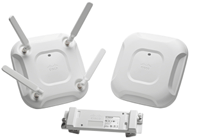
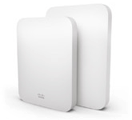 The Aironet line of wireless APs has for years been the market leading AP product. Aironet access points run the gamut from entry-level models to advanced APs. The Aironet family span several generations of devices compliant with the evolving 802.11x Wi-Fi specification. The latest portfolio of Aironet wireless access points support Cisco's Unified Wireless Network architecture and include 802.11ac support, which delivers three times the performance plus superior distance and density compared to the prior generation of APs. Cisco's current dual-band Aironet APs continue to support 802.11n at 2.4 GHz for clients that do not have 802.11ac radios.
The oldest Aironet APs are outdated devices that have reached end-of-sale status and are not supported by Cisco. Progent continues to support the entire Aironet line of wireless access points and can assist your company to maintain your existing Aironet wireless environment or upgrade efficiently to current Aironet technology. For more information about Progent's consulting services for both current and outdated Aironet access points, refer to Aironet APs system design and troubleshooting.
Cisco's Meraki Wireless Access Points
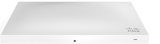
 Cisco's portfolio of Meraki dual-band indoor access points range from budget-friendly models for general use to advanced products supporting up to 5.9 Gbit/sec performance. Every Cisco Meraki indoor access point provides high-end features like plug-and-play installation, advanced security, BYOD support, extensive traffic analysis, automatic over-the-web updates, and unified cloud-based management via an intuitive dashboard. Every Cisco Meraki indoor AP also includes dual powerful client-serving radios with boosted reception as well as a separate radio that offers (WIDS/WIPS) security for RF analysis and deep packet inspection at line rate.
Meraki outdoor wireless access points are IP67 rated, built to withstand rugged outdoor conditions, and able to resist dust particles, vibration and moisture. Cisco's Meraki outdoor wireless access points include a 1 x Gbit Ethernet port and offer advanced capabilities such as cloud management with network-wide visibility, 802.1X integration, built-in antivirus scan (NAC), 1-click guest access and guest isolation firewall, application-aware traffic shaping, plus self-configuring mesh with MIMO. For details about Progent's support for Cisco's Meraki access points and management, refer to Cisco's Meraki APs planning and support.
Cisco's Catalyst 9100 Line of Wi-Fi 6 and W-Fi 6E APs
 Cisco's Catalyst 9100 line of Wi-Fi 6/6E access points are designed for environments ranging from telecommuter homes to high-density convention centers. Cisco Catalyst 9100 APs are compliant with the 802.11ax standard, known as Wi-Fi 6, which is an evolution of the previous 802.11ac (Wi-Fi 5) specification. As an improvement to 802.11ac, Wi-Fi 6 is able to use both the 2.4-Ghz and 5-GHz radio bands. Important technologies incorporated in Catalyst 9100 Series APs include OFDMA scheduling for high density deployments, dual NAVs for better dependability, TWT for conserving power consumption in battery-dependent endpoints, adaptive power and sensitivity thresholds for more efficient spectrum utilization, and dynamic fragmentation for reduced overhead. Catalyst 9100 Series Wi-Fi 6 access points can run Cisco's EWC, accommodate as many as 400 clients per Wi-Fi radio, and run on Cisco IOS XE Software.
 Cisco's Catalyst 916x Series Wi-Fi 6E access points are the first Cisco access points with the versatility of being monitored and managed either on-premises via Cisco DNA Center platform or via the cloud by using Meraki management tools. This permits businesses to transition to cloud-based or hybrid management environments on their own timetable. All Catalyst 916x access points meet the a/b/g/n/ac/ax and 6E Wi-Fi standards and include support for the new 6-GHz band. Each device has 5 radios and allows as many as 400 clients per radio. Each AP also contains a dedicated radio for Cisco CleanAir Pro for reducing wireless interference, comes with a USB 2.0 port, and supports Bluetooth Low Energy (BLE). Cisco's small-footprint Catalyst 9162 Series access point is suited for small businesses, incorporates three 2x2 radios, and includes 1x 100M/1000M/2.5G mGig Ethernet support.
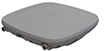 Cisco's Catalyst 9163E Wi-Fi 6E access point is designed to withstand tough outside venues like campus environments or stadiums. The 9163E includes three client serving 2x2 radios, an IoT radio, and a tri-band scanning radio. Interfaces include 1x 100M/1000M/2.5G mGig Ethernet, a management console port (RJ-45), 4x N-Type Wi-Fi antenna connectors, and an RP-SMA active GPS/GNSS antenna connector. The 9163E works with Omnidirectional Dipole Self-Identifying Antennas. The Catalyst 9164 Series access point is meant for small and middle-size enterprises, includes one 2x2 radio and two 4x4 radios, and features 1x 100M/1000M/2.5G mGig Ethernet. The Catalyst 9166 Series Wi-Fi access point is intended for large and mid-sized organizations, includes three 4x4 radios, and provides 1x 100M/1000M/2.5G/5G mGig Ethernet support. The 9166 also includes environmental sensors that detect air quality, temperature, and humidity. For details about Progent's consulting services for Catalyst 9100 Line of 802.11ax APs, refer to Wireless APs solution planning, configuration, and troubleshooting consulting.
Cisco 9800 Series 802.11ax Wi-Fi 6 Wireless Controllers
Cisco's Catalyst 9163E Wi-Fi 6E access point is designed to withstand tough outside venues like campus environments or stadiums. The 9163E includes three client serving 2x2 radios, an IoT radio, and a tri-band scanning radio. Interfaces include 1x 100M/1000M/2.5G mGig Ethernet, a management console port (RJ-45), 4x N-Type Wi-Fi antenna connectors, and an RP-SMA active GPS/GNSS antenna connector. The 9163E works with Omnidirectional Dipole Self-Identifying Antennas. The Catalyst 9164 Series access point is meant for small and middle-size enterprises, includes one 2x2 radio and two 4x4 radios, and features 1x 100M/1000M/2.5G mGig Ethernet. The Catalyst 9166 Series Wi-Fi access point is intended for large and mid-sized organizations, includes three 4x4 radios, and provides 1x 100M/1000M/2.5G/5G mGig Ethernet support. The 9166 also includes environmental sensors that detect air quality, temperature, and humidity. For details about Progent's consulting services for Catalyst 9100 Line of 802.11ax APs, refer to Wireless APs solution planning, configuration, and troubleshooting consulting.
Cisco 9800 Series 802.11ax Wi-Fi 6 Wireless Controllers
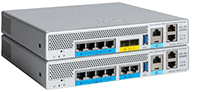 Catalyst 9800 Series Wi-Fi 6-supported wireless controllers help you automate and manage advanced Wi-Fi environments that incorporate 802.11ax access points. 802.11ax, aka Wi-Fi 6, builds on previous generation 802.11ac (called Wi-Fi 5) devices by delivering lower latency and more predictable performance, allowing higher client density, offering greater protection, saving energy for battery-dependent handheld devices, and offering more flexibility for handling new types of Internet-of-Things endpoints. Catalyst 9800 line wireless controllers feature high availability with seamless software upgrades, live patching, and the ability to add access points with zero downtime. Advanced security technologies include Encrypted Traffic Analytics (ETA), secure boot, and Cisco Software-Defined Access (SD-Access). Streaming telemetry permits you to track and analyze network and client health.
All appliances in the Catalyst 9800 line are based on Cisco's IOS XE Software and work with Cisco's DNA Center (DNAC) or Cisco Prime Infrastructure management platforms. Cisco's Catalyst 9800 Series wireless LAN controllers can manage Cisco Aironet Wi-Fi 5 Wave 1 and Wave 2 access points as well as Catalyst 9100 Wi-Fi 6 access points. For details about Progent's consulting services for Cisco 9800 line of 802.11ax Wi-Fi 6 Wireless Controllers, refer to Catalyst 9800 Series Wi-Fi 6 wireless controllers solution design, configuration, and debugging services.
Cisco Wi-Fi 5 Wireless LAN Controllers
Cisco Wave 2 Wi-Fi controllers allow realtime data exchange, configuration, control, analysis and troubleshooting for Cisco wireless appliances and software services. Cisco offers both hardware and virtual Wi-Fi controllers for unified administration of wireless environments, but systems with many wireless APs typically require physical Wi-Fi controllers. Wave 2 Wi-Fi controller devices from Cisco offer significant benefits in comparison to Wave 1 and older products such as greater throughput, simultaneous support for both 1G and 10G interfaces, enhanced application visibility and control (AVC), and hardened, built-in protection.
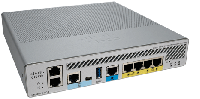 Cisco's 3504 Wireless Controller is a value-priced device available in a desktop body and intended for small and medium-sized businesses. You can install the 3504 in a centralized network environment such as in small branch and remote offices administered over the WAN with Cisco FlexConnect, or in bridge installations where Ethernet cabling is limited. The 3504 wireless controller supports as many as 150 WiFi access points and 3,000 users, offers 4 Gbps performance, and supports 4,096 VLANs. The 3504 controller includes a Cisco Multigigabit interface and four 1-Gigabit Ethernet connections. APs can be attached directly to the WiFi controller via two PoE ports. The 3504 Wi-Fi controller offers fast failover for APs and users, which allows nonstop availability for apps. Like other Wave 2 Wi-Fi controllers from Cisco, the 3504 model has the built-in ability to communicate with Cisco Prime Infrastructure, Cisco Mobility Services Engine, and Cisco 5520 and 8540 WiFi controllers.
 Cisco's 5520 WiFi Controller, available in a 1 rack unit (RU) enclosure, is designed to support larger enterprises and campus networks and can be run in centralized, distributed, and mesh deployments. The 5520 wireless controller supports up to 1,500 Wi-Fi access points and 20,000 clients, offers 20 Gbps performance, and supports 4,096 VLANs. The 5520 wireless controller includes two 10 GE ports and incorporates SSD storage, backup fans, optional redundant power supplies, and rapid failover for nonstop availability.
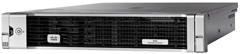 The Cisco 8540 Wireless Controller, offered in a 2RU package, is a high-end WiFi controller designed to support large enterprises, service providers, and large campuses. The 8540 WiFi controller can be used in centralized, distributed, and mesh deployments and supports up to 6,000 APs and 64,000 clients. The 8540 WiFi controller can deliver throughput up to 40 Gbps and supports up to 4,096 VLANs. The 8340 comes with four 1-GB or 10GE ports and features SSD storage, dual power supplies, redundant fans, and subsecond failover.
Wave 1 Cisco WiFi LAN Controllers
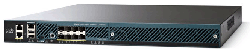 Cisco wireless LAN controllers reduce the effort and cost required to deploy, manage, and operate Wi-Fi networks by centralizing control of functions like provisioning wireless access points, enforcing single-point policies across converged wired and wireless LANs, supporting enterprise-wide QoS for IP voice and video, monitoring and optimizing system health, activating intrusion prevention tools to defend against unauthorized access and Distributed Denial of Service attacks, and managing IPv6 clients. Cisco has designed wireless LAN controllers for organizations of all sizes and offers desktop or rackmount appliances, modular add-on wireless controllers for Cisco ISR routers and Catalyst switches, and switches with integrated wireless LAN controllers.
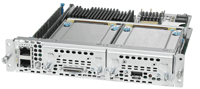 Cisco's Wave 1 WiFi LAN controllers include Cisco CleanAir technology to avoid RF interference and create self-healing and self-optimizing wireless LANs for maximum 802.11n and 802.11ac throughput and security. Integrated Bonjour Gateways allow discovery, advertisement and policy throughout the enterprise for Apple-based applications. For high availability (HA), Cisco wireless network controllers support access point and client stateful failover by enabling a backup HA controller to synchronize with a main controller for AP license tabulation, CAPWAP state and roaming keys, and AP CAPWAP state. If the main wireless controller goes down, thousands of access points and clients can failover at subsecond speeds to the backup wireless network controller.
Cisco's Wireless Controller Module for ISR Routers with UCS-E provides basic 802.11n and 802.11ac support for 2900 and 3900 routers used by smaller organizations and satellite offices. This affordable and expandable solution can handle from five to 200 wireless access points and up to 6000 clients. (To find out concerning Progent's online and onsite consulting support services for Cisco routers, see Cisco router configuration and management support.)
Catalyst 3650 Series are 1RU form-factor switches designed for small to mid-size businesses and branch offices and come with an integrated wireless controller with the capability to support up to 40 Gb of wireless capacity per switch and 25 APs and 1000 clients per switch. Cisco Catalyst 3850 Series are 1RU switches intended for midsize businesses and large enterprises and feature a built-in wireless controller with up to 40 Gb of wireless capacity per switch and the ability to handle up to 50 APs and up to 2000 wireless clients. The Wireless Services Module2 is a plug-in blade for Cisco Catalyst 6500 Series switches that include a built-in wireless network controller intended for mid-to-large size businesses and able to deliver 20 Gbps throughput and with support for up to 1000 APs and up to 15,000 clients. (To find out concerning Progent's consulting services for Cisco switches, refer to Cisco Catalyst switches deployment and troubleshooting support.)
Cisco 2500 Wireless Controllers are entry-level desktop units that simplify the deployment and operation of Wi-Fi LANs for small to medium-sized enterprises and satellite offices. The Cisco 2500 Series wireless network controller can handle 5 to 75 APs and 1000 wireless clients and offers sustained performance of up to 1 Gbps.
 Cisco's 5500 Series Wireless Controller is a scalable 1RU unit designed for medium-sized to large businesses and campuses and can manage 500 access points and 7,000 clients while delivering 8 Gbps performance. Cisco's 5760 Wireless Controller is a 1RU appliance designed for mid-to-large campus environments with the ability to manage up to 1000 wireless access points and 12,000 clients and offering performance of 60 Gbps to accommodate high client densities and high usage of media-rich applications.
Cisco's Flex 7500 Series Wireless Controller is designed to enable centralized management of thousands of wireless branches from a single location, eliminating the need for a Wi-Fi controller at every branch. The 1RU Flex 7500 allows you to create a private cloud to configure, track, maintain, and troubleshoot as many as 6000 APs and up to 64,000 clients while supporting 1 Gbps throughput. The Cisco 8500 Wireless Controller is a 1RU rackmount device engineered to monitor and manage wireless networks for large campuses or for service providers and can be expanded to support 6000 APs and up to 64,000 clients while delivering 10 Gbps throughput.
To learn more about Cisco wireless controllers, go to Cisco Wi-Fi controllers consulting services.Legacy Cisco Access Points, Bridges and Controllers Supported by Progent
The 802.11ac standard for Wi-Fi effectively made obsolete all earlier generations of Wi-Fi devices for many venues that have high numbers of clients and high usage of video-intensive software applications. Even for businesses who do not currently require the performance of 802.11ac Wi-Fi, a large number of Cisco wireless products have reached end-of-sale or end-of-support status, which can pose significant maintenance and compliance problems. Progent's Cisco-certified consulting experts provide remote and on-premises support services for a broad range of older-generation Cisco wireless products. Progent can in addition help organizations to assess the financial justification for upgrading up-of-date wireless technology and can assist in planning and executing cost-effective, non-disruptive migrations. The following are a few of Cisco legacy wireless devices that Progent's consulting experts still support.
Legacy Cisco Aironet APs
Aironet 1000 or 1130AG Series access points are intended for offices and other locations which have minimal environmental instability. These devices include built-in antennas that provide predictable radio coverage patterns. The 1130G family product is designed for controlled locations that do not permit 5GHz operation.
Cisco Aironet 1230AG/1240AG Series APs are designed for more challenging RF situations such as manufacturing plants and warehouses or above ceiling structures which typically require flexible protruding antennas and durable cases. The Cisco Aironet 1240G family access point is intended for restricted locations that do not allow 802.11a operation.
Aironet 1500 Series lightweight outside mesh LAN access points provide an affordable, scalable, secure outdoor wireless network mechanism for enterprise campuses and for public sites that need connectivity for mobile devices.
Legacy Cisco Aironet Wireless Bridges
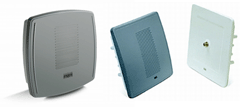 Cisco Aironet wireless bridges offer a high-speed and feature-rich solution for connecting numerous LANs in a metropolitan situation or public wireless environment. Cisco Aironet wireless LAN bridges provide a flexible, manageable solution that meets the security requirements of public networking specialists. They handle both point-to-point and PMP implementations with excellent range and the ability to handle data rates as high as 54 Mbps.
Cisco wireless bridges offer throughput substantially faster than E1/T1 links for a fraction of the cost, doing away with the requirement for costly leased lines when connecting separate offices. Since bridges require no periodic costs, the expenses saved on leased-line services rapidly pay for the initial equipment costs. Private lines and even leased lines using copper or optical cable often require considerable up-front costs if they are impeded by obstacles like freeways, train tracks, or lakes and rivers. Cisco wireless bridges can be deployed rapidly an offer a fast ROI.
Cisco 1300 family outdoor access points/bridges can be deployed as stand-alone wireless access points, wireless bridges, or workgroup bridges. These devices have a durable enclosure and provide fast, affordable wireless interfaces between multiple stationary or mobile networks and users.
Cisco 1400 wireless bridges offer high-performance, reliable outdoor wireless bridging for LOS environments. These devices include a ruggedized cover that can withstand severe outdoor conditions and can function within broad temperature ranges.
Legacy Cisco WLAN Controllers
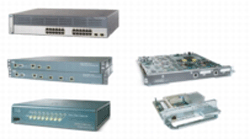 Cisco Wireless LAN Controllers centralize the management of wireless LANs by simplifying the control of common functions including integrated IPS, fast RF control, zero touch configuration, and full N+1 redundancy. Wireless Network controllers operate with lightweight access points to offer superior throughput and high-end administration capabilities.
Cisco WLAN Controllers (WLCs) provide the manageability, scalability, security, and dependability that system managers need to create secure, large-scale wireless solutions, from branch offices to small businesses to headquarter campuses. Cisco's legacy Wireless Network Controllers can be clustered to offer support for as many as 2400 WAPs for each roaming domain.
The Cisco WLCM or WLCM-E Wireless LAN Controller Module for IS Routers offers small-to mid-size businesses and large corporations a cost effective solution to implement and manage protected WLANs at satellite offices. These products supervise up to a dozen Cisco Aironet wireless access points and are installable in 2800/3800 IS Routers and 3700 Series IS Routers. (To learn concerning Progent's online and on-premises consulting services for Cisco routers, see Cisco router deployment and troubleshooting consulting.)
How Progent's Consultants Can Assist Your Business with Cisco Wireless Technology
Progent can provide access to a Cisco-certified expert to help your business to design, install, manage and repair a converged wired and wireless ecosystem integrating a wide array of wireless products that provide the identical security, extensibility, and ease of management you demand from a wired environment. Progent can assist you to manage early-generation Wi-Fi solutions from Cisco or upgrade seamlessly to the latest 802.11ax Wi-Fi 6 technology. Progent's CISM, CISSP, and ISSAP security professionals can advise you about how to build protection into your wireless network and into your business operations. Progent's disaster recovery planning consultants and business continuity consultants can assist you to deploy the HA technology incorporated into Cisco's wireless and wired products so your converged infrastructure provides non-stop return on investment.
Progent's Wireless Site Survey helps you to design and deploy a state-of-the-art wireless network customized for your facilities, providing a wireless ecosystem that delivers seamless coverage, high performance and capacity, QoS features to accommodate IP video, enterprise-class security, and streamlined management. Progent's Wi-Fi Site Survey can be performed remotely to cut time and costs, or onsite for more challenging facilities.
For a further discussion of Progent's wireless consulting services, see Progent's Wireless Support. To learn more information about Progent's consulting expertise for Cisco solutions, select a subject:
- Overview of Cisco Consulting Services
- Fast Remote Support from a CCIE Engineer
- Cisco Firepower NGFW Series Firewalls: Configuration and Troubleshooting Support
- Cisco ASA 5500-X Series Firewall with Cisco Firepower: Integration and Management Expertise
- ASA 5500 Firewall Engineering Services
- Cisco PIX Series Firewall Engineering Expertise
- Cisco Routers Configuration and Troubleshooting Support
- Cisco Aironet APs Deployment Services
- Cisco Small Business 100, 300 and 500 Wireless APs Consulting Services
- Cisco Catalyst Wi-Fi 6/6E Access Points Solution Design, Configuration and Troubleshooting Consulting
- Cisco WiFi Controllers Experts
- Meraki Wireless Access Points Engineering Services
- Cisco Unified Communications Manager (CUCM or Unified CM) and CallManager Consulting and Troubleshooting
- Cisco Voice over IP Phones and IP Video Phones Expertise and Wireless VoIP Phone Solutions
- Cisco Jabber Integration Expertise
- Cisco Catalyst Switches Consulting and Support Services
- Nexus Switches Consulting and Support Services
- Cisco Meraki MS Switches Deployment Expertise
- Cisco VPN Consulting Expertise
- SIP and CUBE Infrastructure Solutions: SIP PSTN Trunks and Cisco CUBE Integration Consulting
- Cisco Duo MFA Two-factor Authentication (2FA) Services for Telecommuters
- Design Solutions for Cisco-powered Data Centers
- Data Center Optimization Expertise for Service Providers
- Centralized Cloud-based and Hybrid Management Techniques for Cisco-powered Environments
If you wish to contact Progent about technical help for Cisco technology, call
Select Topic: