Cisco Certified Expert Network Consultants
Cisco VoIP Phones and Unified CM/CallManager Consulting
From Cisco CCIE Collaboration-Certified Telephony Experts
 Sending live voice and video over IP (VoIP and Video over IP) has evolved from simply being being a shrewd means to cut phone carrier bills to a required technology for productive collaboration. Unified communications, at one time limited to managing Internet-based voice calls and faxing on one platform to replace expensive PBX systems, now includes voice and video, mobility, IM, presence, collaboration services, and more in a cohesive ecosystem that is easy to manage, scalable, protected, fault-tolerant, economical, and intuitive.
Cisco is the leader in providing solutions for supporting the current model of unified communications (UC). Cisco's unified communications solution adds to the efficiency of information systems by slashing operational costs; integrating multiple collaboration functions with familiar software applications to increase worker output; supporting collaboration among employees, partners, and vendors to save effort and enhance business results; and streamlining the support of your converged voice and data ecosystem.
Cisco's UC solutions include these main product categories:,
- Call Control Platforms for managing rich media calls and sessions
- IP Phones and Softphones to enhance worker productivity
- Unified Communications Software Applications for easy access to real-time, IM, voice and video, phone messages, desktop sharing, and conferencing
- Communications Gateways for providing connectivity with public networks and remote users
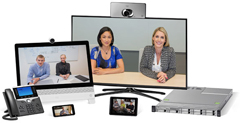 Cisco's call-processing agent is the centerpiece of the Cisco IP collaboration portfolio and gives you the flexibility to implement a centralized call-processing design, a decentralized model, or a mix of both. In a centralized approach, Unified Communications Manager (UC Manager or CUCM) extends enterprise phone capabilities to packet telephony network devices such as VoIP handsets, media processing products, Voice over IP gateways, and multimedia applications across the IT environment. Cisco Unified Communications Manager enables additional voice, video, and data functions including unified messaging, video conferencing, and collaborative customer interaction networks.
The latest release of Cisco Unified CM, formerly known as CallManager, includes a variety of improvements that accelerate ROI by cutting management and support expenses, improving worker output, facilitating collaboration, supporting the BYOD model of computing, elevating data protection, and making efficient utilization of network infrastructure. Headline new features include automatic dial-plan replication, simplified certificate control, expanded support for single sign-on for managers and end users, device-independent call recording, mobile connectivity with no need for VPN tunneling, a revamped self-provisioning utility that makes it easy for workers to manage their preferences for all of their endpoint devices, and support for Secure Real-Time Transport Protocol for mobile users.
When you deploy a centralized Cisco Unified Communications Manager cluster to control voice processing for customers at distributed locations, IT managers can help achieve non-stop phone availability through Cisco SRST, an IOS Software image for routers. If a WAN connection breaks, Cisco SRST in the Cisco router provides core Unified Communications Manager functions until the link is returned. For a description of Progent's consulting support services for Cisco routers, refer to consulting support services for Cisco Integrated Services routers.
For small business networks, branch locations, and retail deployments that do not need the complete functionality offered by Unified CM, Cisco Unified Communications Manager Express, formerly named CallManager Express offers an economical PBX alternative that handles the needs of locations with as many as 450 workers. Because Cisco Unified Communications Manager Express Unified Communications Manager Express (Unified CCX) is embedded in the IOS Software running on a Cisco ISR router, smaller offices can rapidly set up a converged voice and data solution.
The Cisco Business Edition 6000 is a line of one-stop solutions that offer fundamental collaboration features such as routing, gateway, high definition voice and video, messaging, IM and presence, voice and video conferencing, and paging support, enabling any end user to connect on any endpoint device from any place. All BE6000 versions come preinstalled with a virtualization hypervisor and collaboration applications, making deployment fast and simple and cutting operating expenses for organizations with up to 1000 workers. All solutions are shipped preinstalled with a virtualization hypervisor and UC applications software. Organizations can instantly activate Unified Communications software applications as their requirements dictate.
The small-scale BE6000S supports five fixed unified communications software applications installed on a single combination 2921V router/gateway/virtualized E1600 M2 blade server device and can handle a maximum capacity of 150 workers and 300 endpoint devices. The mid-market Business Edition 6000M includes four collaboration software application options activated on a virtualized Cisco C220 M4 server and supports up to 1000 users, 1200 endpoint devices, and 100 contact center agents. The high-end BE6000S Supports 8 unified communications software application options enabled on a single virtualized Cisco C220 M4 server and has the capacity for as many as 1000 users, 2500 devices, and 100 contact center agents.
For more information about Progent's support for Unified Communications Manager (CallManager), visit Unified Communications Manager (CUCM or Unified CM) and CallManager design, integration, upgrades and troubleshooting.
Cisco IP Phones: IP Voice and IP Media Endpoints
A collaboration endpoint is an end-user instrument, either a physical handset or a software phone application on a PC or mobile computer. In the IP world, every IP phone has an Ethernet connection. VoIP phones have all of the functions that an analog phone handset provides, but Voice over IP phones often provide additional functions such as the ability to access the web or host collaboration software.
 In contrast to traditional PBX technology, in a Cisco IP communications network you can implement virtually instantaneous moves, additions, and changes. You merely move the VoIP handset to its new location, plug it into an Ethernet connection, and the handset registers itself with Cisco Unified Communications Manager. All client privileges and configurations are programmatically re-established, doing away with the cost and delay of sending support personnel to wiring closets. Another efficient feature is extension mobility, which allows you to log into any Cisco IP device and receive your own phone extension and privileges.
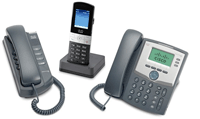
Cisco offers a wide range of collaboration handsets. Cisco's low-cost SPA 300 family are basic IP and Digital Enhanced Cordless Telecommunications (DECT) phones that feature high-quality voice, compatibility with hosted IP telephony environments or an IP private branch exchange (PBX), simple installation and highly secure remote installation, transparent software updates, and web-based set up. The value-priced SPA301 is a one-line VoIP endpoint with no screen or speakerphone, a base dialer with one Ethernet connector, and a corded handset with no keys. The SPA302D, intended exclusively for operation with the Cisco SPA232D Multi-Line DECT ATA, is a multiple-line wireless Digital Enhanced Cordless Telecommunications (DECT) IP phone that supports 10-lines, a TFT 176 x 220 pixel color screen, and a dial pad with speakerphone capability. The SPA303 is an economical three-line IP phone with two switched ports, a 128x64 mono display and a speaker.
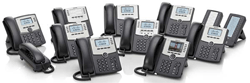 The SPA500 family VoIP phones are affordable devices that support SIP and SPCP call control protocols, two Ethernet switch ports, speakerphones, Power over Ethernet, and conferencing support. Most versions have a 128 x 64 pixel mono screen display, The SPA501G has eight lines and has eight soft keys but no hi-res display. The SPA502G has a single line and has no soft keys. The SPA504G VoIP phone supports four lines and has four programmable keys. The SPA508G IP Phone supports eight lines and eight programmable keys. The SPA509G IP Phone supports 12 lines and features 12 programmable buttons. The SPA512G IP Phone supports four lines, no programmable keys and supports 1xGb Ethernet. The SPA514G supports four lines, has soft buttons, and supports Gigabit Ethernet. The top-of-the-line SPA525G2 includes a 320 x 240 color display, supports five lines, and includes five programmable buttons.
Cisco's IP Phones 3900 Series and IP Phones 6900 Series are specialty VoIP devices intended for occasional-use environments such as lobbies, elevators, and conference centers. The Unified SIP Phone 3905 IP Phone features a 128 x 32 mono display, a 10/100 Ethernet switch, a speakerphone, and Power over Ethernet. The bare-bones Cisco Unified IP Phone 6901 is a single-line device with no display and requires a hook switch for transferring a call and conferencing.
Cisco's 7800 line of value-priced IP phones are VoIP desktop endpoints with backlit monochrome screens, four soft buttons, 11 fixed-feature buttons, an Ethernet port with Power over Ethernet (PoE), and an integral speakerphone. Cisco's 7800 Series IP Phones support only the SIP signaling protocol. All devices in the 7800 line incorporate the same advanced speakers and microphones as Cisco's 8800 Series IP phones to provide a best-in-class audio solution. Cisco's EnergyWise power-save technology, available on the advanced 7800 models, cuts off-hours energy consumption by up to 60 percent. The Cisco IP Phone 7811 is a one-line phone intended for shared locations as well as for workers with infrequent call requirements. The IP 7811 comes with a 3.28-inch 384 x 106 display and a narrow-band speakerphone. Wideband audio is available through an extra-cost handset. Cisco's IP Phone 7821 is a dual-line VoIP phone with a 396 x 162 screen. The IP Phone 7841 is a four-line endpoint with a 396 x 162 screen and is the only model in the 7800 line that provides 1xGb Ethernet. The top-of-the-line IP Phone 7861 is a 16-line endpoint targeted for administrators, call center personnel, and managers who have heavy voice communications needs.
The Cisco Unified IP Phone 7900 Series are dual-protocol (SIP/SCCP) media devices with a 320 x 240 pixel color display, an integral 10/100/1000 Ethernet switch, Class 3 Power over Ethernet (PoE), 10 fixed-feature keys and a speakerphone. The Cisco Unified IP Phone 7945G is a two-line device and the Cisco Unified IP Phone 7965G includes four lines. Both IP phones include a 5-inch display and four soft buttons. The Cisco Unified IP Phone 7975G device is an eight-line media phone with a 5.6-inch touch screen and five soft buttons.
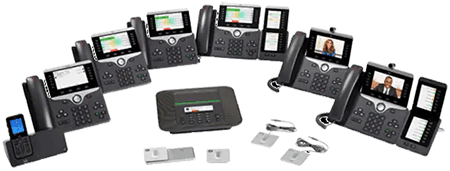
Cisco's IP Phone 8800 Series is a family of SIP-only IP phones that features desktop devices, a conference IP phone, and wireless IP Phones. The desktop models are five-line IP phones featuring a 5-inch 800 x 480 pixel display, a Gigabit Ethernet switch, a speakerphone, four programmable keys and 12 fixed-feature buttons. Cisco's IP Phone 8811 includes a mono display and supports Class 2 Power over Ethernet (PoE). The Cisco IP Phone 8841 has a WVGA color screen and supports Class 2 Power over Ethernet. Cisco's IP Phone 8845 features a WVGA color display, 720p HD video, a tiltable camera, Bluetooth, Cisco Intelligent Proximity for Mobile Voice, and supports Class 2 PoE. The Cisco IP Phone 8851 has a WVGA color display and one USB port with charging capability, supports Intelligent Proximity for Mobile Voice and Class 3 Power over Ethernet, and is offered in Bluetooth and non-Bluetooth models. The Cisco IP Phone 8861 includes a WVGA color screen, Bluetooth, two USB connections with charging capability, and supports Cisco Intelligent Proximity for Mobile Voice, 802.11ac Wi-Fi, and Class 4 Power over Ethernet. The Cisco IP Phone 8865 includes a WVGA color display, 720p HD video, an adjustable camera, Bluetooth, dual USB ports with charging capability, and supports Cisco Intelligent Proximity for Mobile Voice, 802.11ac Wi-Fi, and Class 4 PoE.
 Cisco's wireless IP phones are industrial-grade Wi-Fi devices designed for professionals who are on the move within campus, hospitality, retail or other venues where IT management requires portable phones that offer more control, security and ruggedness than is possible with the Bring-Your-Own-Device mode of mobile communications. Cisco's 8821 and 8812-EX wireless VoIP phones provide on-the-move onsite workers the advantages of voice over wireless LAN (VoWLAN) technology in workplaces with 802.11a/b/g/n/ac Wi-Fi. Cisco's 8821 Wireless IP Phone features a hi-res color screen, a rugged case rated Mil-SPEC 810G to withstand dropping and IP67 for particulate and moisture resistance, extended batteries, a built-in speakerphone, and a Bluetooth 4.0 radio for hands-free operation with cordless headsets. The 8821-EX Wireless VoIP Phone adds anti-sparking protection for potentially combustible environments. Cisco's 8821-EX also features a case composed of industry-standard yellow plastics, which makes it easier to locate the event of a crisis. Find out about Progent's Wireless IP Phone integration and troubleshooting support.
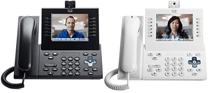 Cisco's discontinued 9900 family of advanced VoIP endpoints integrate high-definition voice with business-grade color displays to provide a rich collaborative unified communications solution for knowledge professionals and executives. Both IP phones in the 9900 family feature a Standard Definition 640x480 pixel color screen, a Bluetooth 2.0 radio to work with a wide range of headsets, and an integrated 1 GE Ethernet switch. The Cisco Power Save function is offered as an option and can cut off-work power consumption by up to 90 percent. The IP Phone 9951 features a 5-inch display and supports up to 2 IP Color Key Expansion Modules for expanding customizable line and function keys. The IP Phone 9971 features a 5.6-inch screen, a built-in Wi-Fi radio for connecting to voice-over-wireless LAN environments, and four programmable touchscreen keys to access Cisco Unified Communications functions. The 9971 IP phone supports up to 3 Cisco IP Expansion Modules for expanding customizable line and feature keys.
Unified Communications Applications
Cisco's discontinued 9900 family of advanced VoIP endpoints integrate high-definition voice with business-grade color displays to provide a rich collaborative unified communications solution for knowledge professionals and executives. Both IP phones in the 9900 family feature a Standard Definition 640x480 pixel color screen, a Bluetooth 2.0 radio to work with a wide range of headsets, and an integrated 1 GE Ethernet switch. The Cisco Power Save function is offered as an option and can cut off-work power consumption by up to 90 percent. The IP Phone 9951 features a 5-inch display and supports up to 2 IP Color Key Expansion Modules for expanding customizable line and function keys. The IP Phone 9971 features a 5.6-inch screen, a built-in Wi-Fi radio for connecting to voice-over-wireless LAN environments, and four programmable touchscreen keys to access Cisco Unified Communications functions. The 9971 IP phone supports up to 3 Cisco IP Expansion Modules for expanding customizable line and feature keys.
Unified Communications Applications
Within Cisco's Unified Communications platform, IP phone, IP video, and other converged applications are physically separate from the call-processing and voice-processing mechanism, and they may reside anywhere within the system. A single connectivity infrastructure offers an open environment for powerful business applications and provides a solid foundation for downstream convergence-based software. Cisco works with third-party IT industry companies to offer a broad range of IP phone and video applications and products. Cisco also enables the ability to create and manage specialized in-house applications.
Unified Communications application software available from Cisco and supported by Progent include:
Jabber
Cisco Jabber is a converge media client application that supports presence, instant messaging, business-quality voice, video, voicemail, desktop sharing, and online conferencing capabilities for PCs, Macs, tablets as well as smartphones. Jabber is an evolution and combination of the Cisco Unified Personal Communicator soft phone, Cisco Mobile, and WebEx Connect, with major improvements in the areas of HD video capabilities and desktop screen sharing, and expanding the collaboration environment to more operating systems and devices. Jabber operates with Cisco Unified Communications Manager for call and session control, Cisco Unified Presence for instant messaging and presence, Unity Connection for voice messaging and programmable attendant, and WebEX Meeting for online meetings.
Because Cisco Jabber is based on popular communication standards, it can interoperate with a broad selection of non-Cisco products. As an example, Extensible Messaging and Presence Protocol (XMPP) allows Jabber users to exchange IM and presence information with other XMPP clients including as Adium, IBM Sametime, and Microsoft Lync and Office Communications Server. Jabber collaboration features are available from Microsoft Office applications such as Outlook and Microsoft SharePoint. This broad platform support optimizes output by providing a common user environment and fully enabling the bring-your-own-device paradigm of networking. Progent can provide the expertise of Microsoft-certified Exchange consultants and SharePoint application developers who can assist you to take advantage of Jabber with Microsoft's popular collaboration platforms. Progent also offers expertise with Apple iPhone and iPad integration and Google Android phone and tablet integration to help your organization to enhance the business value of your BYOD environment.
WebEX Meeting Center
WebEX Meeting Center provides web and video conferencing for participants using a browser or virtually any PC or mobile device. WebEx Meeting Center is delivered as software as a service via the Cisco WebEx Cloud. This makes it simple to roll out and expand, reduces the cost of administration, avoids high up-front expenditures, features high availability and enterprise-grade security, and delivers fast performance. Important capabilities include the ability to share discrete content or an entire screen with remote participants in real time, the ability to incorporate multimedia into your presentations including Microsoft PowerPoint and Flash videos, network-based recording plus playback for training, single sign-on and support for Cisco collaboration products such as Jabber and Cisco TelePresence, plus strong data protection and encrypted connections with strict policy management.
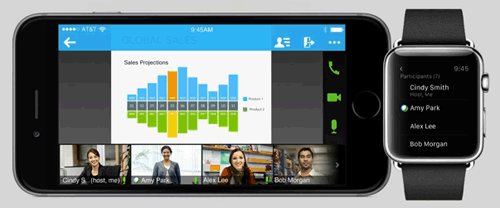
Cisco WebEx Meeting Center works with Microsoft Windows, Apple Mac, and Linux-powered desktops and allows mobile users to start, schedule, and participate in conferences on Android devices, Apple iPhones and iPads, BlackBerry handhelds, and Microsoft Windows Phone. You can also launch web meetings instantly from Microsoft Office, Microsoft Outlook, Notes, and a selection of IM applications.
Cisco TelePresence Products for In-house Video Conferencing Environments
For midsize organizations and enterprises who wish to build a local or hybrid local/cloud solution for video conferencing, Cisco offers a portfolio of Cisco TelePresence software and equipment that deliver high-quality video conferencing for users with almost any IP endpoint at any site. Cisco TelePresence Server is an expandable video conferencing bridge that works in conjunction with Cisco Unified Communications Manager to deliver multiparty telepresence to converged deployments and can expand meetings to support cloud-based WebEx Meeting Center participants. Cisco TelePresence Conductor software streamlines the control of how conferencing resources are allocated for each participant, allowing managers to define the precise service level and experience needed for every user. Cisco TelePresence Content Server captures video conference presentations for live streaming as well as video on demand viewing.
Cisco's Unity Connection and Unity Express for Unified Voice Messaging
Cisco's Unity Connection, an extension of Cisco Unified CM, is a unified voicemail platform that facilitates collaboration by providing a variety of options for accessing voice messages within an environment that is simple to implement and manage. Unity Connection allows you to read and manage your voicemail messages from your email inbox, browser, Cisco Jabber, a Cisco Unified VoIP Phone, an iPhone or other smartphone, or an iPad or tablet. Unity Connection also offers sophisticated voice-recognition capabilities for hands and eyes free operation and extensive Automated Attendant features such as smart routing for inbound calls and custom call-filtering and message-notification options. The Unity Connection system operates as a fully virtualized system that can reside on a Business Edition 6000 server or a Cisco SRE 910 router blade and can accommodate as many as 20,000 voice mailboxes per server.
Unity Express (CUE), offered in certain Cisco Integrated Services routers, offers affordable voicemail, unified messaging, interactive voice response (IVR), and greeting services for small to medium businesses (SMBs) and enterprise branch locations with as many as 500 workers. Cisco Unity Express allows you to manage voicemail messages using a Cisco Unified IP Phone display, a browser, or an email system. Cisco routers for which Unity Express is available as an advanced integration module include Cisco's 1861, 2900, and 3900 Series. Progent can provide comprehensive consulting and support services for Integrated Services Routers.
Cisco Unified Contact Center
Unified Contact Center Enterprise (Unified CCE or UCCE) works with Cisco Unified Communications Manager and agent desktop apps like Cisco Finesse to offer automatic call distribution capabilities that allow an organization to connect customers with the proper sales or service agent. Unified CCE offers intelligent call routing, computer telephony integration (CTI), multichannel customer contact management, call queuing, interactive voice response and advanced company-wide reporting to simplify the deployment and administration of a modern contact center. Cisco products supporting Unified CCE's customer contact management ecosystem include Unified IP Phones, Cisco Voice Gateways, and Cisco LAN/WAN technology.
Unified Contact Center Express (Unified CCX) offers an out-of-the-box solution for building a customer contact center for mid-scale systems that handle as many as 400 agents. Multiple bundles are offered, as well as a selection of special options. Unified CCX integrates closely with Cisco CUCM and offers intelligent call distribution, client management, integrated reporting, IVR, and the ability to manage voice, email, chat, and social media requests. Unified CCX includes Finesse, a web-based desktop agent that needs no client-side software setup. Optional enhancements include call-in-queue, expected-wait-time messages, and workforce quality management.
Cisco Mobile Connect for Single Number Reach
Mobile Connect, commonly referred to as Single Number Reach, makes it possible for users to be reached via one number that rings at the same time on their desktop IP Phone and their smartphone. Users can switch live calls between their Cisco IP phone and their cell phone seamlessly. Calls that are not answered can be redirected to a Unity or Cisco Unity Connection account. Users can create their own access lists that specify which calls get extended to alternate endpoints.
Cisco Prime Collaboration Provisioning
Cisco Prime Collaboration Provisioning offers an automated platform for first-time deployments and for follow-on moves, additions, changes, and deletions. An intuitive interface provides a unified look at a subscriber and the subscriber's services. Prime Collaboration significantly accelerates company-wide installations and minimizes the time required for ongoing changes. Prime Collaboration in addition provides management analytics that show technology adoption and consumption trends, allowing organizations to optimize resources and further reduce TCO.
Cisco Communications Gateways
Cisco's collaboration gateways allow Cisco converged communications environments to connect with other systems and with clients working beyond the corporate firewall. Cisco's portfolio of gateways provide unified communications support for a wide variety of gateway as well as session-border-control applications.
Collaboration gateways offered by Cisco and supported by Progent's certified consultants include:
Expressway Converged Communication Gateway
Cisco's Expressway is a powerful converged media gateway that enables organizations to provide employees, suppliers, customers and prospects, or partners who are using different networks, workgroup platforms, or endpoint devices to access to Cisco Unified Communication services. The Expressway collaboration gateway works in conjunction with an enterprise Cisco CM system or Cisco BE6000, or can be run via the cloud with Cisco HCS to make productive collaboration more universal. Important features of Expressway are include:
- Mobile and Remote Access: Remote workers with any Jabber-compatible desktop or handheld computer or telecommuters with Cisco TelePresence endpoints have the convenience of single-sign-on (SSO) as well as Transport Layer Security (TLS) and can access all their collaboration applications (high-definition video, business-quality voice, data IM, and realtime presence) without requiring the extra step of a VPN connection. In addition, teleworkers can use their Cisco TelePresence endpoints without a VPN, delivering a user experience at home the same as the corporate office.
- Jabber Guest Support: Cisco Expressway is critical for supporting Jabber Guest, which allows “guests” to communicate with your organization easily and safely through streamlined browser and mobile multimedia phone calls.
- Cisco Cloud Access: Expressway can act as a gateway that connects between onsite Cisco or non-Cisco systems and Cisco's WebEx cloud. By offering support for Cisco Collaboration Meeting Rooms (CMRs), Expressway deliver a world-class, scalable conferencing experience that seamlessly integrates voice, video, and content sharing to anyone, at any location, using any device.
- Interoperability: In case your organization already has non-Cisco video products, Cisco Expressway can assist you to migrate efficiently to Cisco products whenever you choose. Cisco Expressway provides video interoperability with industry standard H.323, H.264 SVC, or SIP environments. Interoperability capabilities allowed by Expressway include IPv4 to IPv6, H.323 to Session Initiation Protocol (SIP), and Microsoft Lync H.264 SVC to H.264/AVC.
The Cisco Unified Border Element is a collaboration edge session border gateway that connects unified communications networks to the IP public switched telephone network. Beyond providing session border control, CUBE provides easy and affordable collaboration beyond the enterprise firewall. Sample unified communications functions supported by CUBE include:
- Cisco WebEx Cloud Connected Audio for SIP-media-connected audio conferencing
- Voice and Video recording
- Enterprise Call-center and IVR solutions
- Policy-based evaluation of voice calls
- Business-to-business teleconferencing over SIP
Cisco's Legacy UC520, UC540 and UC560 VoIP Phone Systems
The legacy Cisco Unified Communications 500 (UC500) Series is a VoIP and unified communications system for small businesses. UC500 models deliver voice, data, voicemail, automated attendant, IP video, security, and WiFi capabilities, work with older generation Cisco VoIP endpoints, and support public switched telephone network connections.
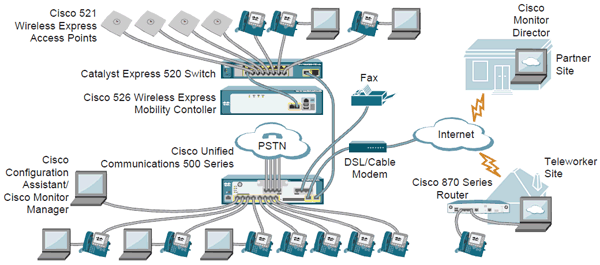
All UC500 series bundles include a desktop switch with 8 Power-over-Ethernet ports plus additional FXS and FXO interfaces, a firewall, and VPN. Built-in WiFi is optional. VoIP user capacity can be expanded by connecting with Cisco Catalyst Express switches. Every UC500 offering also includes software licenses for Cisco Unified Communications Manager for VoIP call processing and Cisco Unity Express software for voice messaging and automated attendant. The Cisco UC520 package supports 8 to 16 VoIP users and include 4 FXS and 4 FXO interfaces. The Cisco UC540 package allows 32 users and has 8 foreign exchange office ports. The Cisco UC560 package supports 48 VoIP clients and 12 FXO ports.
Progent's seasoned VoIP experts can help you to support your legacy UC500 VoIP system or design and implement an efficient upgrade to a modern VoIP system like the Cisco Business Edition 4000.
How Progent Can Assist You with Cisco VoIP and IP Media Phones, Cisco Unified CM, and Video Conferencing
Progent offers remote or onsite help from a certified CCIE Collaboration specialist to assist your business to plan, deploy, manage and repair unified communications networks supported by Cisco Unified Communication technology in a centralized, distributed, or hybrid environment. Progent's Cisco-certified consultants have in-depth experience integrating Cisco Unified Communications Manager and Cisco CallManager, VoIP phones and soft phones, UC applications such as Jabber and Unity Connection, Cisco's video conferencing products, communication gateways, utilities built into Cisco Catalyst switches and routers. Progent can also offer expertise with related technologies like Cisco SRST, Cisco Unified Border Element, H.323 and SIP gateways, Call Admission Control, IP voice trunks, various signaling protocols, and Cisco's AVVID architecture. Progent's SIP integration consultants can in addition help you to create SIP infrastructure environments that include SIP VoIP phones and video phones, SIP-based CUBE trunks, and SIP administration tools with Cisco Unified Communications Manager.
Progent's custom application developers can create specialized IP telephony applications that will help your company to integrate the features of Cisco Unified Communications Manager into your company processes for increased productivity. Progent can evaluate your current network and Internet connectivity infrastructure to make sure your environment is configured to support business-quality VoIP and high-definition video, help you to choose and deploy Cisco hardware and software that make sense for your present needs and downstream growth goals, and interface your Cisco Unified Communications solution with technology from other suppliers. Progent's CISSP-ISSAP certified network security and compliance consultants can assist you to create, implement, and validate a comprehensive security and compliance strategy for your converged communications ecosystem. Also, Progent can assist your organization to deploy Cisco fault-tolerant technologies like Cisco Unified SRST to provide cost-effective call control redundancy in remote-branch and teleworker sites, and Progent's disaster recovery planning experts can help you create a viable disaster recovery plan to protect your business-critical communications environment.
Cisco Unified Communications Manager/CallManager Upgrade Services
Releases of Cisco Unified Communications Manager 8.6 earlier than 8.6 and every release of its predecessor CallManager have reached end-of-life. This means Cisco Engineering will cease to enhance, repair, or validate the product software. Security patches for this pivotal product will end, which in some circumstances could create compliance or legal liability problems.
Progent will continue to provide expert consulting and troubleshooting support for outdated editions of Unified Communications Manager and CallManager, but if you are still using an out-of-dated release of this critical software you should begin immediately to plan your upgrade. Progent's Cisco-certified consulting professionals can assist your company to upgrade smoothly to the current version of Cisco Unified Communications Manager and can typically save customers up to 50% off consulting service expense versus competing computer service companies because of Progent's documented procedures and experience in this area. By adhering to leading practices, Progent can make sure your business gets a fast payback on your IT investment by showing you how to benefit fully from the enhanced feature set, reduced administrative and support expense, more engaging collaboration capabilities, and tighter security provided by the latest edition of Cisco Unified Communications Manager.
Progent's upgrade services include ROI analysis, project management or co-management, pilot testing, Cloud integration, setting up collaboration endpoints from Cisco and other suppliers, smartphone and tablet integration, security and compliance services, management automation, disaster recovery/business continuity planning, network infrastructure design, training, and ongoing consulting services and troubleshooting. Progent also has put together fixed-priced migration packages to keep your costs visible and under control. To find out more information concerning Progent's professional assistance for Cisco networking products, select a topic:
- Introduction to Progent's Cisco Expertise
- Timely Remote Support from a CCIE Network Engineer
- Cisco Firepower NGFW Series Firewalls: Configuration and Management Expertise
- ASA 5500-X Series Firewall with Firepower: Consulting and Troubleshooting Services
- ASA 5500 Firewalls Management Help
- Cisco PIX 500 Series Firewall Maintenance Assistance
- Cisco Routers Consulting Services
- Cisco Wireless Deployment Services
- Cisco Aironet Access Points Consulting Support
- Cisco Small Business Wireless Access Points Engineering Support
- Catalyst 802.11ax Wi-Fi 6/6E Wireless Access Points Planning, Configuration and Debugging Services
- Cisco Wireless Controllers Experts
- Cisco Meraki Wireless APs Deployment Help
- Cisco Unified Communications Manager (CUCM or Unified CM) and Cisco CallManager Integration and Technical Support
- Cisco Jabber Consulting and Support Expertise
- Catalyst Switches Engineering Services
- Cisco Nexus Switches Deployment Expertise
- Meraki Switches Support and Troubleshooting Services
- Cisco VPN Setup and Troubleshooting Help
- SIP and CUBE Integration Solutions: SIP PSTN Trunks and CUBE Integration Consulting
- Cisco Duo MFA Two-factor Authentication Services for Remote Workers
- Infrastructure Design for Cisco-based Datacenters
- Infrastructure Optimization Services for Service Providers
- Centralized Cloud-based and Hybrid Network Management Solutions for Cisco-powered Environments
To contact Progent about technical support for Cisco technology, phone